Space exploration in 2026 is a study in contrasts. On one hand, engineers are bolting together rockets and spacecraft that will carry humans farther than they've traveled in half a century. On the other, mission timelines are being rewritten, budgets are being squeezed, and the orbital environment around Earth is becoming dangerously crowded. This is a moment when genuine progress and genuine risk are advancing side by side—and understanding both sides of that story is essential to understanding where spaceflight is really headed.
NASA's Artemis Program: Hardware Progress, Architecture Upheaval
NASA's Artemis program, designed to return humans to the Moon and eventually support missions to Mars, has had a busy few weeks on the factory floor.
On July 30, 2026, technicians at Kennedy Space Center's Neil Armstrong Operations and Checkout Building joined the Orion crew module to its service module for the Artemis III mission—a critical assembly step that brings the spacecraft closer to flight readiness. A few days earlier, on July 21, the fourth and final RS-25 engine arrived at the Vehicle Assembly Building from NASA's Stennis Space Center in Mississippi, completing the set of four engines that will power the core stage of the Space Launch System (SLS) rocket.
These are tangible, meaningful steps. But they sit alongside a much bigger story: NASA has fundamentally restructured what Artemis III will actually do.
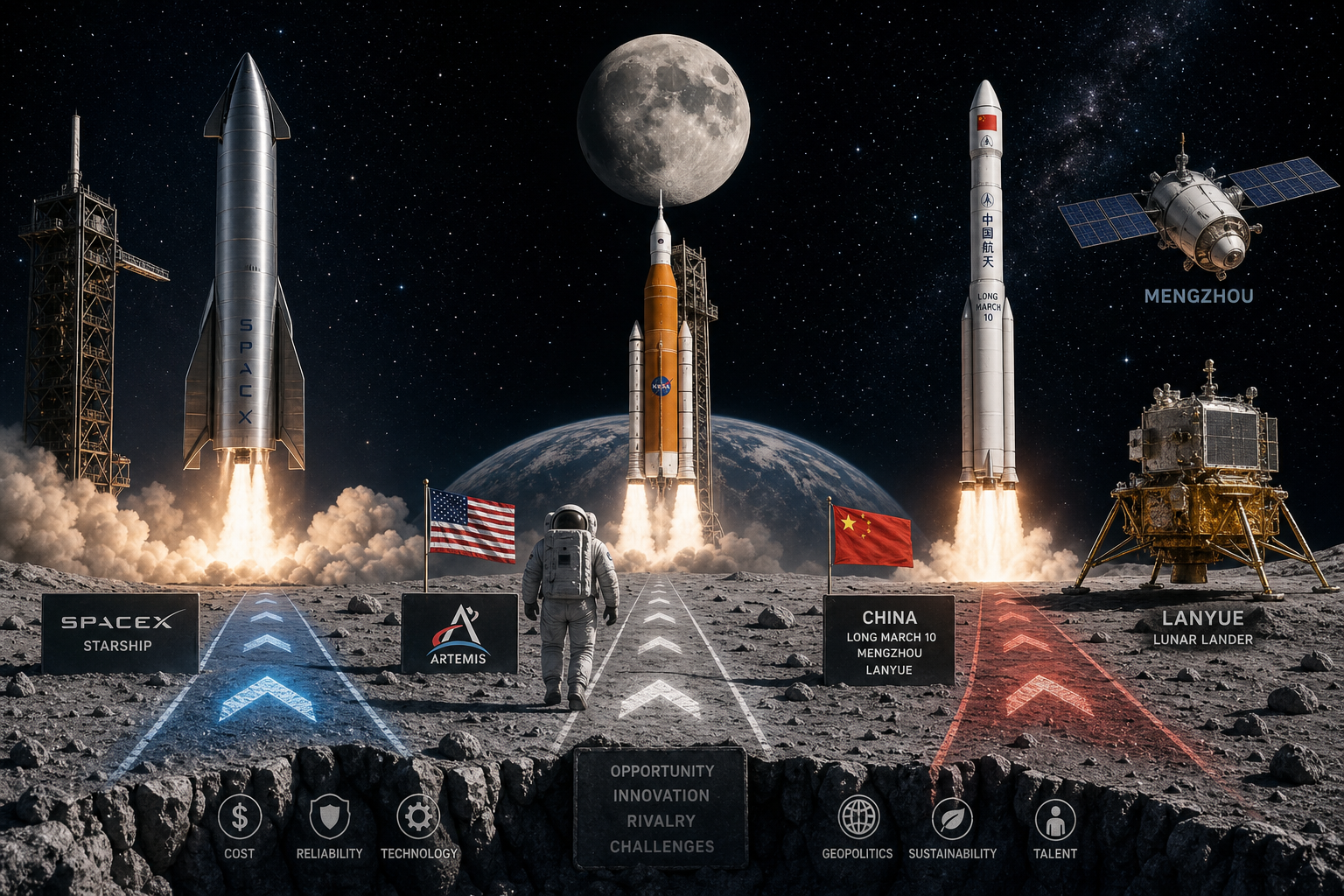
Originally conceived as the mission that would land astronauts back on the lunar surface for the first time since Apollo, Artemis III has now been redefined. Following a February 2026 announcement, NASA says Artemis III will instead serve as a crewed flight test focused on rendezvous and docking between the Orion spacecraft and commercial lunar landers being developed by Blue Origin and SpaceX. In practical terms, this means astronauts will practice the complex choreography of meeting up with a lander in space—but the first crewed landing at the lunar south pole has been pushed back to Artemis IV.
This is a significant schedule change, and it hasn't come without cost. A Government Accountability Office (GAO) report found that in revising the focus of Artemis III, IV, and V, NASA has paused work on three separate Artemis-related projects, including development of the Gateway lunar space station—an outpost intended to orbit the Moon and support future surface missions.
The financial picture is even starker. A NASA Inspector General audit identified four major Artemis systems, with a combined contract value of $5.9 billion, that are now slated for cancellation or repurposing. These include the SLS Exploration Upper Stage (a more powerful second stage for the rocket), the Universal Stage Adapter, Mobile Launcher 2 (the tower structure used to assemble and launch the rocket), and the HALO module, which was meant to serve as a core habitation and logistics component of the Gateway station. All four systems, according to the audit, experienced billions of dollars in cost increases and years of delays before reaching this point.
Compounding the pressure, NASA's workforce shrank by more than 20% in 2025 as part of broader government-wide reduction efforts, a change that has rippled across many of the agency's projects and likely contributed to the difficult decisions about which systems to keep funding.
It's not all setbacks, though. The Orion capsule has already proven itself in flight: the Artemis II mission successfully sent four astronauts on a journey around the Moon, marking the first crewed lunar mission in over 50 years. And despite the headline-grabbing cancellations, most NASA projects have actually stayed within their cost and schedule targets—a detail that's easy to overlook amid the more dramatic news about Gateway and the Exploration Upper Stage.
SpaceX Starship: A Promising Splash, and a Hard Crash
If Artemis represents incremental hardware progress wrapped in organizational turbulence, SpaceX's Starship program in 2026 tells a similarly two-sided story—except played out in real time, on camera, over the Indian Ocean.
In July 2026, SpaceX conducted the 13th test flight of Starship, the second flight this year of the redesigned V3 version of the vehicle. As with the previous test, neither the booster nor the upper-stage spacecraft was intended to be recovered; this was purely a data-gathering exercise. And the data was, in some respects, very encouraging. During reentry, the Starship spacecraft came down over the Indian Ocean, hovered upright, and then gently lowered itself into the water—what SpaceX described as the best reentry performance the vehicle has achieved to date.
The test also produced some genuinely novel engineering insights. SpaceX used its own Starlink satellites to photograph Starship's heat shield during the fiery reentry process, while onboard sensors measured atmospheric pressure across the vehicle's surface. In a deliberate stress test, some heat-shield tiles were painted white to simulate missing tiles, allowing engineers to study how the vehicle handles damage or gaps in its thermal protection—information that will be critical for eventually making Starship safe for repeated, reusable flights.
But the mission wasn't a clean success. After the booster separated from the upper stage and attempted to return to Earth, its landing burn appeared to fail, and instead of achieving the pinpoint landing SpaceX has demonstrated in the past with earlier Starship boosters, it crashed hard into the water.
Industry analysts have been careful not to overstate the progress. Satellite industry expert Tim Farrar noted that while the test showed real advancement, SpaceX "remains a long way from achieving rapid reusability of the entire ship," specifically citing ongoing problems with relighting the Raptor engines—a capability essential for controlled landings. The GAO's assessment was similarly measured, stating that SpaceX faces major challenges in getting Starship ready for operational use, and specifically flagging cryogenic fuel management technology (the systems needed to keep super-cooled rocket propellants stable, especially during long stays in space or during propellant transfer between vehicles) as "a top risk for the program."
Why does this matter so much? Because NASA is counting on Starship. The agency hopes to use a version of the vehicle to land astronauts on the Moon as soon as 2028, partly driven by a desire to beat China to a crewed lunar return. But as CNN observed in its coverage of the July test, "Starship has a long way to go before it's ready to fly with people, much less execute a crewed lunar touchdown." The gap between where Starship is today and where it needs to be for a human landing is still substantial—and the clock is ticking.
China's Steady March Toward 2030
While the United States juggles competing priorities and shifting mission architectures, China's lunar program has been advancing with notable consistency. The country's key hardware for a crewed Moon landing—the Long March-10 rocket, the Mengzhou crew spacecraft, and the Lanyue lunar lander—has reportedly progressed smoothly, with major milestone tests already completed. These include escape tests for the Mengzhou spacecraft (verifying that the crew capsule can safely separate from a malfunctioning rocket) and landing and liftoff trials for the Lanyue lander.
China also has a robotic mission on the near-term horizon. The Chang'e-7 mission, expected to launch in the second half of 2026, will search for water ice at the lunar south pole using a "hopping" probe—a vehicle capable of making short, controlled jumps across the lunar surface to investigate multiple sites, including permanently shadowed craters where ice is thought to be trapped.
Beyond the technical milestones, there's a strategic dimension worth noting. China's Tiangong space station could become the only continuously crewed outpost in orbit once the International Space Station—led by NASA and its international partners—is retired sometime between 2030 and 2032. That timing creates an interesting overlap: just as the ISS era ends, China's lunar ambitions may be reaching their culmination.
On the specific timeline, sources broadly agree that China is targeting a crewed Moon landing around 2030, though the interim milestones vary slightly depending on the source. IEEE Spectrum has reported that Mengzhou's first robotic (uncrewed) flight is planned for 2026, with Lanyue's uncrewed test following in 2027, then a joint uncrewed test of both vehicles together in 2028 or 2029, ahead of the crewed landing roughly a year after that. The policy research organization RAND has cited similar milestones with slightly different dates for the joint Mengzhou-Lanyue uncrewed test, but the overall trajectory described by different analysts points in the same direction: steady, methodical progress toward a 2030 crewed landing.
The Overlooked Crisis: Orbital Debris and a Crowded Sky
While lunar ambitions dominate headlines, a quieter but arguably more urgent problem is unfolding much closer to home—in the increasingly cluttered orbital space just above Earth's atmosphere.
As of January 2026, current estimates suggest that more than 140 million pieces of debris exist in space, the vast majority concentrated in Low Earth Orbit (LEO), the region that hosts the International Space Station and the overwhelming majority of commercial satellites. Of that enormous number, only a fraction can actually be tracked: approximately 29,245 objects larger than 10 centimeters are actively monitored by the US Space Surveillance Network as of 2026. Everything smaller—paint flecks, bolts, fragments from old collisions—remains essentially invisible to current tracking systems, yet still capable of causing catastrophic damage at orbital velocities.
The pace at which this risk is accelerating is genuinely alarming. The European Space Agency's 2026 Space Environment Report introduced a metric called the "CRASH Clock," which estimates how long it would take for a catastrophic collision to occur in LEO if all satellite operators suddenly lost the ability to maneuver their spacecraft out of harm's way. As of mid-2025, that window had shrunk to somewhere between 2.8 and 5.5 days. For comparison, the same metric stood at 121 days back in 2018—a staggering reduction in the margin for error in less than a decade.
This trend has fueled growing concern among researchers about a phenomenon known as Kessler syndrome, or a Kessler cascade: a scenario in which collisions between objects generate debris fast enough to trigger further collisions, creating a self-sustaining chain reaction that could eventually render parts of LEO unusable. This idea, first proposed decades ago as a theoretical concern, is no longer being treated as purely hypothetical. Some researchers now argue that LEO may already be in the early stages of such a cascade.
A major driver of this congestion is the rapid growth of satellite mega-constellations. SpaceX's Starlink network alone now has more than 10,931 active satellites in orbit, and it is not alone—Amazon's Project Kuiper and China's Qianfan and GuoWang constellations are adding further capacity, fundamentally changing the density calculations that govern how crowded LEO has become. In response to sustainability concerns, SpaceX has announced plans to lower roughly 4,400 Starlink satellites from an altitude of 550 kilometers down to 480 kilometers throughout 2026. This lower orbit would cut the time it takes for defunct satellites to naturally deorbit and burn up in the atmosphere by about 80%, reducing how long dead hardware lingers as a collision hazard.
Unfortunately, policy and regulation have struggled to keep pace with the technical realities. The 2024 Orbital Sustainability (ORBITS) Act, which was designed to fund commercial active debris removal efforts in the United States, had still not passed into law as of March 2026, leaving a significant funding gap in efforts to address the problem at scale.
On the technical side, there are promising but modest steps forward. The European Space Agency's ClearSpace-1 mission, scheduled for launch in 2026, will attempt to demonstrate the first active debris removal mission in history, aiming to capture and deorbit a single piece of debris weighing about 112 kilograms. The mission carries a price tag of roughly €86 million—a figure that illustrates just how expensive and slow current cleanup technology remains relative to the enormous scale of the debris problem. Removing one 112-kilogram object at that cost is a meaningful technical achievement, but it also underscores how far current capabilities are from addressing millions of tracked and untracked fragments.
The Numbers at a Glance
| Metric | 2018 | 2026 |
|---|---|---|
| CRASH Clock (time to catastrophic LEO collision if maneuvering stopped) | 121 days | 2.8–5.5 days |
| Tracked debris objects (larger than 10 cm) | — | ~29,245 |
| Estimated total debris pieces in orbit | — | 140+ million |
| Active Starlink satellites | — | 10,931+ |
Where Experts Agree—and Where Uncertainty Remains
Across these four major storylines, there's a fair amount of consensus among space agencies, industry analysts, and government watchdogs. Most observers agree that 2026 marks a genuinely pivotal year, with the successful Artemis II crewed lunar flyby and the restructured Artemis III mission signaling a real, if complicated, return to crewed lunar-adjacent spaceflight. There's also broad agreement that orbital debris and satellite congestion represent a rapidly worsening structural problem—not a distant hypothetical risk, but an active and accelerating challenge. And most analysts view China's lunar program as credibly on track for a 2030 crewed landing, a timeline that is putting real competitive pressure on NASA's own plans.
Where there's less agreement is in the details. Artemis mission dates and architecture have shifted multiple times throughout 2026 alone, making it genuinely difficult to predict exactly what the program will look like even a year from now. And perhaps the most consequential uncertainty hangs over Starship: NASA's leadership has expressed public optimism about the vehicle being ready to support a crewed lunar landing by 2028, while independent analysts and government auditors have repeatedly flagged serious unresolved engineering challenges, particularly around cryogenic propellant management.
What's clear is that space exploration in 2026 isn't a simple story of steady advancement. It's a more complicated picture—one of real hardware milestones achieved alongside real institutional strain, of dramatic test-flight successes paired with hard crashes, and of ambitious lunar goals set against a backdrop of an orbital environment that is becoming measurably more hazardous with each passing year. Whether the next few years bring a triumphant return to the Moon or a series of further delays and course corrections will likely depend as much on how well these interconnected challenges are managed as on any single technological breakthrough.