For over a century, two of physics' greatest achievements have refused to shake hands. General relativity, Einstein's theory of gravity, describes the smooth curvature of space and time on cosmic scales. Quantum mechanics governs the jittery, probabilistic behavior of particles at the smallest scales. Both theories work brilliantly within their own domains, yet they resist unification into a single coherent framework. Bridging that gap remains one of the deepest open problems in physics.
But the past couple of years have brought a wave—quite literally, in some cases—of new data and renewed theoretical effort. From an explosion of gravitational-wave detections to cracks appearing in our standard model of the universe's expansion, and from laboratory experiments chasing the quantum nature of gravity to a half-century-old paradox about black holes, researchers are converging on this problem from multiple directions at once. Here's a tour of where things stand.
A New Era of Gravitational Wave Astronomy
When the LIGO and Virgo detectors first picked up the gravitational-wave signal from two colliding black holes in 2015, it confirmed a prediction Einstein had made a century earlier and opened an entirely new way of observing the universe—one based not on light, but on ripples in spacetime itself. A decade later, that new observational window has widened dramatically.
The LIGO-Virgo-KAGRA collaboration has been steadily expanding its catalog of confirmed detections, and the pace of discovery has accelerated sharply. In March 2026, the collaboration released an updated catalog documenting 128 new gravitational-wave signals detected over a nine-month observing period—a substantial jump compared to the 90 detections recorded in earlier catalogs. Just two months later, in May 2026, an even larger release added 161 newly identified signals from black hole mergers observed between April 2024 and January 2025, bringing the total number of confirmed gravitational-wave events since 2015 to 390.
This acceleration isn't accidental. A series of technical upgrades to the LIGO detectors, combined with the 2024 relaunch of the Virgo detector in Italy, has significantly boosted the network's sensitivity. Where earlier observing runs might have caught a handful of events per month, the improved detectors are now capturing an estimated three to four gravitational-wave signals every week.
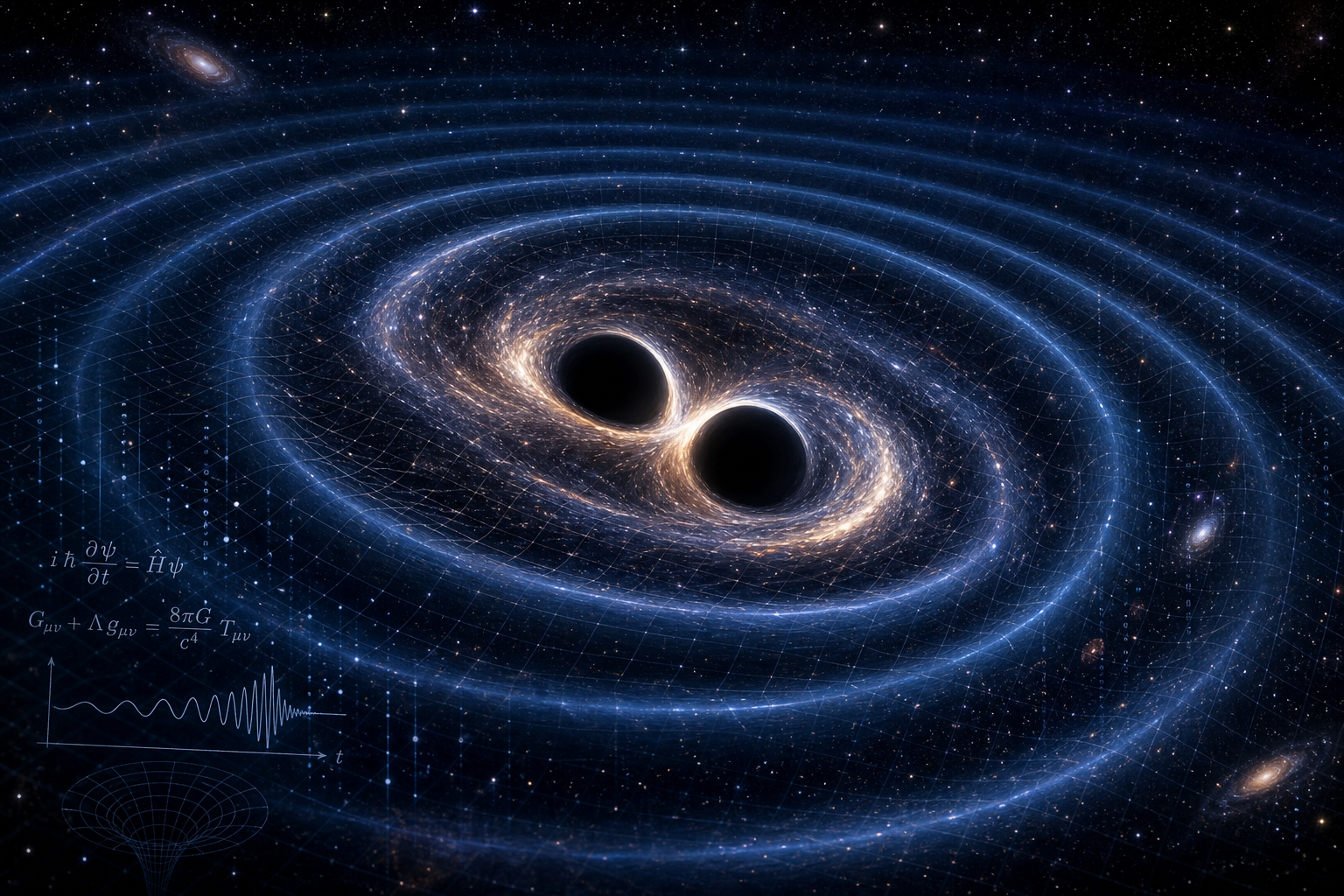
Among the hundreds of new detections, a few stand out as especially significant.
GW250114 — detected on January 14, 2025 — produced the clearest gravitational-wave signal ever recorded, with a signal-to-noise ratio of 76.9, meaning the signal stood out from background noise with extraordinary clarity. The event was caused by the merger of two black holes with nearly identical masses, around 32 and 34 times the mass of the sun. The exceptional quality of this signal allowed researchers to identify three distinct gravitational-wave "tones" for the first time, effectively hearing multiple overtones of the black hole merger's final ringdown. This gave scientists the opportunity to conduct the most stringent tests of general relativity yet performed using gravitational-wave data.
GW240615 set a different kind of record: the most precise sky localization ever achieved for a gravitational-wave source. This merger, involving black holes of roughly 26 and 30 solar masses, was pinpointed to a patch of sky just six square degrees across—a remarkably tight fix for an event detected purely through gravitational effects rather than light.
Taken together, the expanded catalog has done more than simply add numbers to a list. It has enabled researchers to refine measurements of the universe's expansion rate, identify evidence for two previously undistinguished types of black holes, trace multiple distinct pathways through which black holes can form, and add further support to Einstein's century-old theory of general relativity.
The pace of discovery isn't slowing down. Following the conclusion of the fourth observing run in November 2025, the detector network is preparing for a six-month intermediate observing period that will bridge the gap before the fifth full observing run, expected to operate between 2028 and 2031.
Dark Energy: Is the Cosmological Constant Really Constant?
While gravitational-wave astronomy has been expanding our catalog of cosmic events, a separate line of research has been quietly challenging one of cosmology's foundational assumptions: that dark energy, the mysterious force driving the accelerating expansion of the universe, remains constant over cosmic time.
The Dark Energy Spectroscopic Instrument, known as DESI, is at the center of this debate. DESI is a substantial international undertaking, involving more than 900 researchers from over 70 institutions and managed by the U.S. Department of Energy's Lawrence Berkeley National Laboratory. Its purpose is to map the large-scale structure of the universe with unprecedented precision, using the positions and distances of millions of galaxies to trace how cosmic expansion has evolved over billions of years.
On its own, DESI's data remain broadly consistent with the standard cosmological model, often referred to as Lambda-CDM, in which dark energy is treated as a constant force. But when DESI's measurements are combined with other major datasets—including observations of the cosmic microwave background, distant supernovae, and the subtle bending of light known as weak gravitational lensing—a different picture begins to emerge. Increasingly, the combined data hint that dark energy's influence may be weakening over cosmic history rather than remaining fixed.
Will Percival, a co-spokesperson for the DESI collaboration, has described this as a genuine shift in scientific thinking: researchers are guided by Occam's razor, favoring the simplest explanation that fits the data, and increasingly that simplest explanation seems to require modifying the standard model of cosmology. An evolving form of dark energy, rather than a strictly constant one, is emerging as a promising alternative.
However, this is far from a settled matter. The scientific community remains divided on how to interpret these signals. Numerous papers published in 2025 and 2026 debate whether the apparent evolution in dark energy reflects genuine new physics or is instead an artifact of systematic effects tied to particular subsets of the data. In one revealing analysis, researchers found that excluding certain galaxy samples from the dataset reduced the statistical significance of the anomaly from 2.6 sigma down to 1.2 sigma—a substantial drop that underscores how sensitive these conclusions are to the details of data selection and analysis. In physics, a result needs a very high level of statistical confidence before it's considered a discovery, so this kind of sensitivity is a reminder that the case for evolving dark energy, while intriguing, is not yet closed.
Chasing the Quantum Nature of Gravity in the Lab
While astronomical observations probe gravity on cosmic scales, a different and rapidly growing research effort is asking a more fundamental question in the laboratory: does gravity itself behave like a quantum phenomenon?
The underlying problem is that quantum mechanics, despite its extraordinary success describing the subatomic world, cannot be the final word on physical reality because it doesn't mesh smoothly with general relativity. Physicists have long suspected that gravity, like every other fundamental force, ought to have a quantum description—but nobody has yet found direct experimental evidence for this, largely because gravity's effects are so weak at the scales where quantum behavior is normally observed.
One of the most promising experimental strategies involves what's known as gravitationally-induced entanglement. The idea is to place two small masses into a delicate quantum state called a spatial superposition—existing, in a sense, in two places at once—and allow them to interact solely through their mutual gravitational attraction. If gravity has quantum properties, this interaction should create quantum entanglement between the two masses, linking their properties in a way that has no classical explanation.
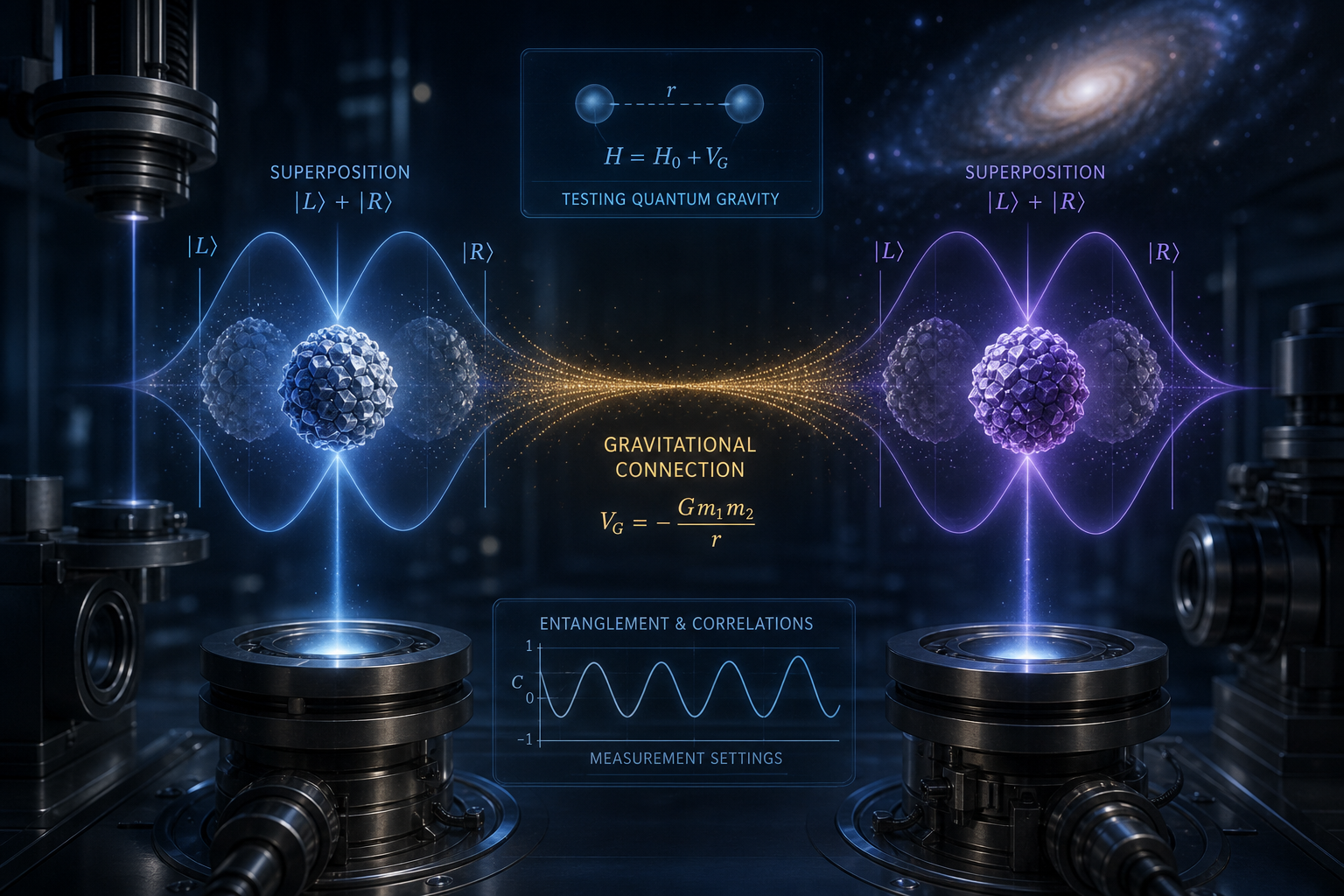
A notable proposal put forward by physicist Sougato Bose and colleagues in 2024 suggests using one nanocrystal in superposition as a kind of detector for another. According to this scheme, the "quantumness" of gravity would reveal itself if the act of measurement on one nanocrystal disturbed the superposition of the other, purely through their gravitational interaction. It's an elegant idea, but an extraordinarily difficult one to carry out. Researchers estimate that such an experiment may be more than a decade away from realization, with the central obstacle being the challenge of cooling relatively large objects down into their lowest possible quantum state of motion—a prerequisite for maintaining a clean, undisturbed superposition long enough to measure gravity's subtle effects.
Progress is being made nonetheless. Scientists achieved ground-state cooling of silica crystals just 150 nanometers across back in 2020, and more recent work has pushed the boundaries further, creating superpositions in sodium nanoparticles containing roughly 7,000 atoms—a significant step up in the size and complexity of objects that can be coaxed into these delicate quantum states.
A separate experimental avenue focuses on the graviton, the hypothetical particle that would carry the force of gravity in a quantum theory, much as the photon carries the electromagnetic force. Detecting individual gravitons directly would be an extraordinarily difficult technical feat, given how weakly gravity interacts with matter compared to the other fundamental forces, but some researchers are pursuing this as an alternative path toward probing gravity's quantum nature.
Importantly, the interpretation of these experiments is itself a subject of active debate. A study published in 2026 cautions that before physicists can claim to have tested gravity's quantum nature, they first need a clear understanding of what evidence would actually prove such a discovery. The concern is that ordinary, classical spacetime effects could potentially be mistaken for genuine signatures of quantum gravity. This caution is reinforced by a 2025 paper published in Nature, which demonstrated that classical—non-quantum—theories of gravity can also produce entanglement under certain conditions. That finding complicates matters considerably, since it means a positive experimental result showing entanglement wouldn't necessarily prove that gravity itself is quantum in nature. Untangling genuine quantum gravitational effects from more mundane classical explanations remains a serious challenge for this entire line of research.
The Black Hole Information Paradox Turns 50
November 2025 marked half a century since physicist Stephen Hawking published his landmark argument that the evaporation of black holes might violate a fundamental principle of quantum mechanics known as unitarity—essentially, the idea that information cannot be truly destroyed, only transformed. This anniversary prompted major retrospective conferences bringing together physicists who have spent decades wrestling with the puzzle Hawking identified.
Despite fifty years of intense theoretical work, the core tension Hawking identified remains genuinely unresolved, and the physics community holds notably diverse views on how—or whether—it can be settled. The table below summarizes the major competing approaches.
| Approach | Core Idea | Proposed Resolution |
|---|---|---|
| Canonically quantized Einstein gravity | Treats general relativity directly within a quantum framework | Information may really be lost—perhaps stored in theoretical "baby universes" or leaked slowly through long-lived black hole remnants |
| String theory | Reformulates gravity within a broader framework unifying it with quantum forces | Considerable evidence suggests information ultimately emerges in the radiation black holes emit; "fuzzball" constructs offer one explicit resolution |
| Wormhole-based approaches | Uses theoretical bridges through spacetime as calculational tools | Helps illuminate black hole geometry and the underlying dynamics behind the paradox |
Despite periodic claims in popular science coverage that the black hole information paradox has been resolved, the reality is more nuanced. As one science journalist observed, the claims that this decades-old puzzle has come to an end are premature—the paradox remains very much unsolved, and represents one of the clearest illustrations of just how much work remains before quantum mechanics and general relativity can be fully reconciled.
A Field in Motion
Taken together, these developments paint a picture of a field very much in motion. Gravitational-wave astronomy has matured from a single landmark discovery into a robust observational science generating hundreds of detections and refining our understanding of black holes and cosmic expansion. Cosmological surveys like DESI are raising serious, if not yet definitive, questions about whether dark energy is truly constant. Laboratory physicists are inching closer to experiments that might finally probe gravity's quantum nature directly, even as they grapple with foundational questions about what such evidence would even look like. And the black hole information paradox, half a century after Hawking first posed it, continues to drive deep theoretical work spanning string theory, loop quantum gravity, and beyond.
None of these threads has yet produced the long-sought unification of quantum mechanics and general relativity. But each represents genuine progress—new data, sharper theoretical tools, and a clearer sense of exactly where the two great theories of twentieth-century physics continue to strain against each other. That friction, uncomfortable as it may be for theorists, is often where the most interesting physics happens next.