For the past few years, the James Webb Space Telescope has been turning up a peculiar class of objects in its deepest images: small, intensely red points of light scattered across the early universe, nicknamed "little red dots." Nobody was entirely sure what they were. Now, a newly identified object called MoM-BH*-1 may finally offer a compelling answer—and it's a stranger one than most astronomers expected.
Proposed in 2026 as a "black hole star," or quasi-star, MoM-BH*-1 appears to be a black hole embedded in a dense, glowing shroud of gas so large it takes on the appearance of a monstrous, overluminous star. It's the first object of its kind ever identified, and researchers say it could be the missing link connecting the earliest supermassive black holes to the mysterious little red dots that JWST keeps finding.
A Survey Built to Catch the Weird and the Wonderful
MoM-BH*-1 turned up during a JWST survey with an unusually candid name: "Mirage or Miracle," or MoM for short. According to Jorryt Matthee of the Institute of Science and Technology Austria (ISTA), one of the study's key researchers, the survey was "designed specifically to target sources considered 'risky,' meaning they could either be amazing discoveries or just interlopers, such as some cold nearby stars that look like distant galaxies."
In other words, the astronomers were hunting for objects that looked like they might be extremely distant galaxies—so distant that their light was emitted when the universe was just a few hundred million years old—while accepting the risk that some of these candidates would turn out to be far less exciting foreground objects. That gamble has already paid off handsomely: the same survey also produced MoM-z14, the most distant confirmed galaxy known.
But among the survey's targets was something that didn't fit into any existing category. The findings were formally published in a peer-reviewed study in Nature, led by Rohan Naidu of the University of Hawaiʻi, with Matthee as a key collaborator and support from MIT. The discovery itself was first shared publicly on the arXiv preprint server on March 20, 2025, alongside a second, related object nicknamed "The Cliff."
A Cosmic Hybrid: Not Quite a Star, Not Quite a Black Hole
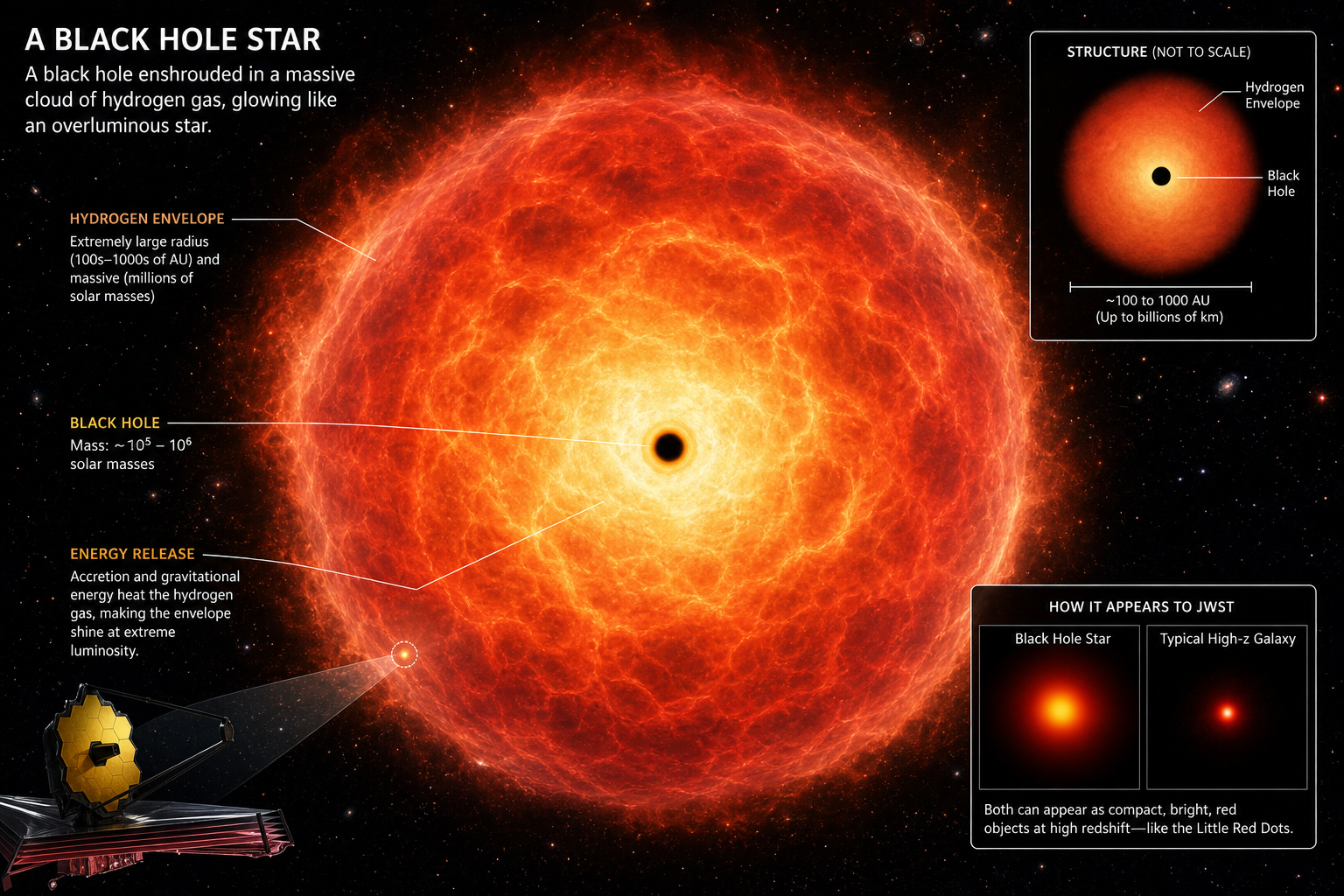
So what exactly is a black hole star? According to the model proposed by Naidu, Matthee, and their collaborators, MoM-BH*-1 consists of a central black hole with a mass roughly 100,000 times that of the Sun, wrapped in an extraordinarily dense envelope of hydrogen gas. That envelope is enormous by planetary standards—stretching out to roughly the size of our solar system—yet it behaves optically much like the outer layers of a star.
This is what makes the object so conceptually strange. A normal star is a ball of gas held up against gravity by the energy released from nuclear fusion in its core. A normal black hole, by contrast, grows by pulling in surrounding matter, which typically spirals inward through a flattened accretion disk before disappearing past the event horizon. MoM-BH*-1 blurs this distinction: it looks, from the outside, like a colossal star, but the energy powering its glow doesn't come from fusion. It comes from a black hole consuming material at a ferocious rate, releasing energy that researchers describe as roughly 100 billion times greater than what any ordinary star could produce.
Crucially, astronomers believe this is a "naked" black hole star—meaning it appears to exist largely on its own in space, rather than sitting at the center of a fully formed galaxy. That detail turns out to be scientifically very useful.
Why a Lone Black Hole Star Matters So Much
One of the biggest obstacles in understanding little red dots has been separating the light coming from the central black hole from the light produced by the surrounding host galaxy. In most little red dots, these two light sources are tangled together, making it extremely difficult to tell what's really driving the object's extreme brightness and color.
MoM-BH*-1 sidesteps this problem almost entirely. Because it appears to exist without a substantial host galaxy of its own, its observed light seems to come almost exclusively from the black hole and its gaseous envelope, with little to no contribution from surrounding stars. In effect, astronomers have stumbled upon a rare, relatively unobstructed view of what a supermassive black hole's core might look like in its rawest form—something like a clean experimental sample amid a field of messier, harder-to-interpret data.
Cracking the Case: A Spectral Clue Called the Balmer Break
The path to identifying MoM-BH*-1 as a black hole star began with a puzzle. Naidu's team noticed that the object showed a strange, sharp drop-off in brightness below certain wavelengths of light. This kind of drop-off is often seen in young stars, where dust filters out shorter wavelengths of light more effectively than longer ones, producing a reddened appearance. But when the researchers looked closely, they found no evidence of the dust that would normally cause such an effect.
Instead, computer simulations suggested a different explanation: a sufficiently dense layer of hydrogen gas surrounding a black hole could produce a strikingly similar drop-off in brightness, without needing any dust at all. Combined with the object's extreme overall luminosity—far beyond what any dust-free stellar population could produce—the simulations pointed toward a black hole embedded in gas as the best explanation.
The specific spectral signature involved is known as the Balmer break, a well-known feature in astrophysics associated with the absorption properties of hydrogen atoms. Stars and galaxies show Balmer breaks of varying strength, but the break observed in MoM-BH*-1 was unusually strong—stronger, in fact, than those seen in typical star-forming galaxies, in dust-free stellar populations, or even in other little red dots. This exceptionally strong Balmer break, combined with the absence of dust, is what tipped researchers off that they were looking at something genuinely new: reddening caused not by dust, but by a dense shroud of gas surrounding an actively feeding black hole.
The object's name reflects this discovery process directly. "The spectrum we detected is our best evidence of a cloak of gas feeding an early-forming black hole," Naidu explained. "Because of its spectrum and with a nod to the survey's name, we dubbed the object 'MoM-BH*-1.'"
A Relic From the Universe's Early Childhood
MoM-BH*-1 isn't just structurally unusual—it's also extraordinarily old. Because light takes time to travel across the cosmos, looking at very distant objects means looking back in time. In this case, the light from MoM-BH*-1 that JWST detected was emitted when the universe was just 660 million years old, a small fraction of its current age of roughly 13.8 billion years. Some accounts describe it as the earliest known example of a black hole star identified to date.
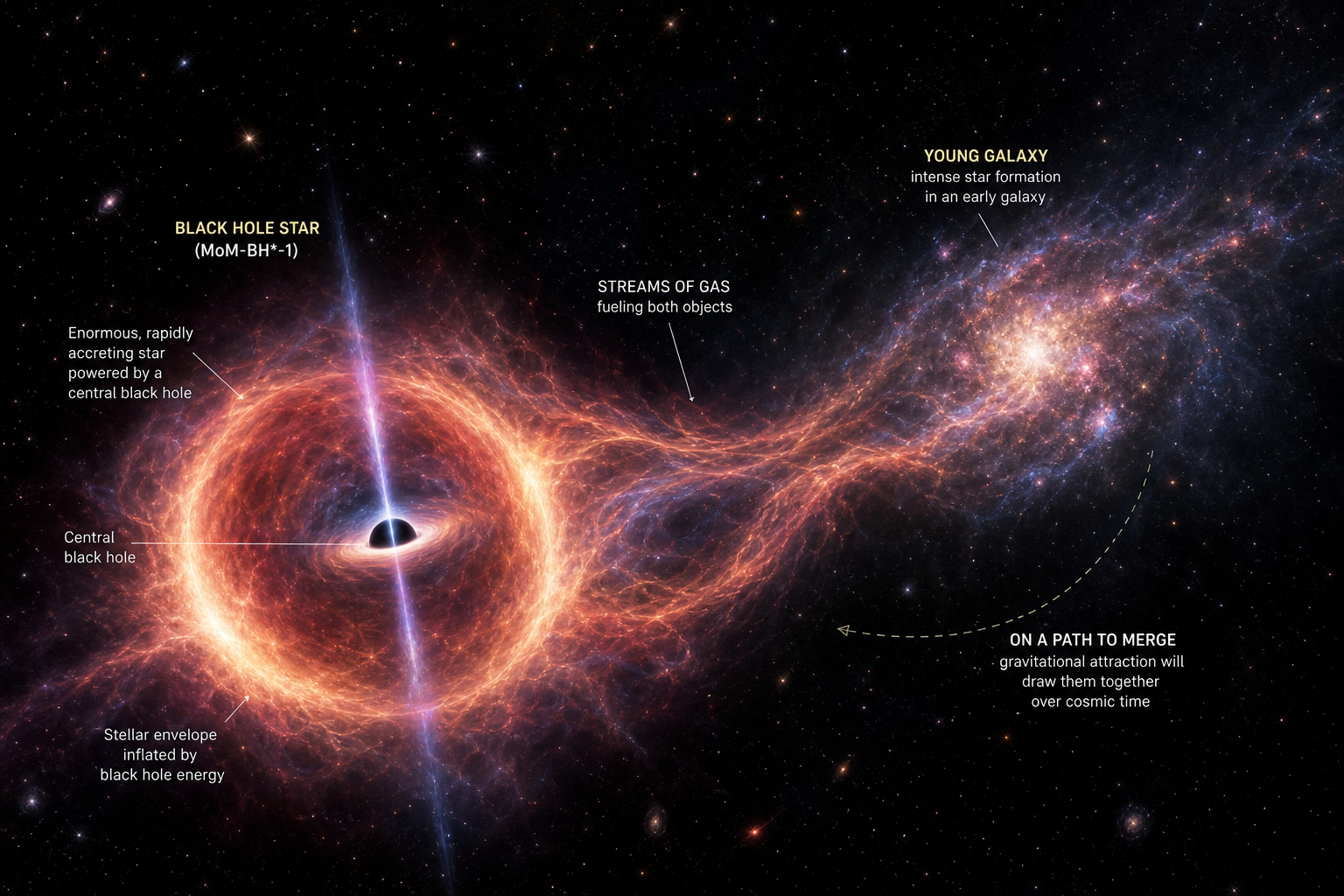
Interestingly, MoM-BH*-1 is not entirely alone in space. It lies relatively close, in cosmic terms, to a young galaxy at the same redshift—meaning the two objects existed at the same point in cosmic history and are likely gravitationally linked. Researchers estimate that within about 100 million years, the black hole star will collide and merge with this nearby galaxy.
The team took the analysis a step further by simulating what this future merger might look like from a distant observer's perspective. By combining the spectra of the black hole star and its neighboring galaxy, they found that the resulting composite spectrum closely resembled the spectra typically seen in little red dots. In other words, MoM-BH*-1 today may look very much like what a typical little red dot will look like tomorrow, once its black hole star becomes embedded within a galaxy.
Rewriting the Story of Little Red Dots
This merger simulation is at the heart of why MoM-BH*-1 matters so much to the broader mystery of little red dots. Since JWST began operating, astronomers have catalogued hundreds of these compact, intensely red objects scattered throughout the early universe—as of 2025, JWST had identified 341 of them. They are also strikingly common: on average, surveys find roughly one little red dot per deep JWST image, making them a widespread rather than rare phenomenon.
Despite their abundance, little red dots have resisted easy explanation. Their unusual colors and compact sizes have made them hard to classify using existing categories of galaxies or active black holes. MoM-BH*-1 offers a new framework for understanding them.
As Matthee put it, "If embedded in similar host galaxies, black hole stars like MoM-BH*-1 might well serve as the central engines of baby quasars. Considering the black hole star as a template for the black hole component of little red dots helps clarify many of the uncertainties about them."
Naidu has framed the implications even more broadly. "Every little red dot is consistent with being a black hole star, embedded in a generic early galaxy," he said. "But what is special about MoM-BH*-1 is, the black hole star is essentially completely outshining its surrounding host galaxy, such that we're seeing pure black hole star light."
If this interpretation holds up, it would mean that many—perhaps most—of the little red dots JWST has observed are essentially the same phenomenon as MoM-BH*-1, just viewed at different stages of merging with their host galaxies, or with varying amounts of galaxy light mixed into their spectra.
MoM-BH*-1 vs. Ordinary Stars and Black Holes
| Feature | Ordinary Star | Ordinary Black Hole | MoM-BH*-1 (Black Hole Star) |
|---|---|---|---|
| Energy source | Nuclear fusion in the core | Gravitational energy from infalling matter | Black hole consuming gas at extreme rates |
| Structure | Gas held up by fusion pressure | Central singularity with a flat accretion disk | Black hole wrapped in a dense hydrogen envelope |
| Size of visible region | Stellar-scale | Accretion disk, typically much smaller than a solar system | Envelope roughly the size of our solar system |
| Luminosity | Standard stellar output | Varies widely | ~100 billion times brighter than an ordinary star |
| Spectral signature | Normal or weak Balmer break | No characteristic Balmer break | Unusually strong Balmer break, no dust |
| Host environment | Typically within a galaxy | Typically at a galaxy's center | "Naked," with no substantial host galaxy detected |
A Possible Answer to an Even Bigger Puzzle
Beyond explaining little red dots, MoM-BH*-1 may also help resolve a longstanding puzzle in cosmology: how did some black holes grow to be billions of times more massive than the Sun so quickly after the Big Bang? Standard models of black hole growth, based on gradual accretion through disks, have struggled to explain how such enormous masses could accumulate in the relatively short time available in the early universe.
A black hole embedded in a dense gas envelope, as modeled in MoM-BH*-1, could potentially grow much faster than a black hole relying on a traditional accretion disk, since it may be able to draw in surrounding material more directly and efficiently. Naidu suggests this growth channel might not be a rare exception but a common evolutionary stage. "We argue that Black Hole Stars may be powering all of JWST's Little Red Dots that are found almost everywhere in the early Universe," he said. "Which is to say, this channel of making massive black holes must be very common, to the point where every massive black hole (like the Milky Way's) may have gone through this phase."
That is a striking claim: it suggests that the supermassive black hole at the center of our own galaxy might once have passed through a black hole star phase remarkably similar to what astronomers are now observing in MoM-BH*-1, billions of years in the past and billions of light-years away.
What Outside Experts Are Saying
As with any bold new claim, independent scientists have weighed in with a mixture of enthusiasm and caution. In an accompanying commentary published in Nature, astronomers Dominik Schleicher and Rodrigo Herrera-Camus, who were not involved in the original study, offered a generally supportive assessment. "Notably, the red color of the system can be explained through the effects of gas, with only a negligible contribution from dust," they wrote, adding that "this discovery provides an important clue about the nature of [little red dots]."
Their framing—describing the finding as "an important clue" rather than a definitive solution—reflects the broader scientific stance so far: MoM-BH*-1 offers a compelling and well-supported model, but confirming that it explains the full population of little red dots will likely require additional observations of similar objects.
Naidu himself has emphasized just how unusual this single discovery is within the context of the vast archives of astronomical data collected over decades. "It is a very special thing to find an object with no comparison, given the vast stores of data on billions of stars, galaxies and black holes that we have in our archival databases," he said. "MoM-BH*-1 is one in a billion!"
A New Chapter in an Ongoing Mystery
MoM-BH*-1 represents a rare case in astronomy where a single well-characterized object can reshape how scientists interpret an entire population of previously puzzling sources. By offering a relatively clean view of a black hole's core—unobscured by galaxy light—it gives researchers a template they can apply to the hundreds of little red dots JWST has already catalogued, and likely many more still waiting to be found.
Whether every little red dot truly harbors a black hole star of this kind remains to be confirmed through further observation. But for now, MoM-BH*-1 stands as one of the most striking discoveries to emerge from JWST's ongoing exploration of the early universe: a genuine cosmic hybrid, neither fully star nor fully black hole, that may hold the key to understanding how the universe's most massive black holes got their start.