The search for planets beyond our solar system has never been more productive—or more contentious. On one hand, astronomers are confirming new worlds at a blistering pace, using an ever-expanding toolkit of detection techniques. On the other, the field's most exciting frontier—determining whether any of these worlds harbor life—is running headlong into the hard limits of current technology. In 2026, exoplanet science finds itself at a fascinating crossroads: enjoying a golden age of discovery while learning painful lessons about the difference between an intriguing signal and genuine proof.
A Milestone Thirty Years in the Making
It has been three decades since the first exoplanet orbiting a Sun-like star was discovered, a find that launched an entirely new branch of astronomy. Since then, the pace of discovery has only accelerated. NASA's official tally of confirmed exoplanets has now passed 6,000, and more detailed tracking shows the number climbing even higher. As of late February 2026, the NASA Exoplanet Archive listed 6,128 confirmed exoplanets, while other trackers place the figure at 6,416 as of April 2026. The European Space Agency (ESA) puts the broader count even higher, noting that more than 7,000 exoplanets have been identified through a combination of space missions and ground-based observatories.
That said, ESA is careful to add an important caveat: for the vast majority of these worlds, astronomers know little more than their size and mass. Confirming a planet's existence is one thing; understanding what it's actually like—its composition, its climate, whether it could support life—is an entirely different and far more difficult undertaking.
How We Find These Worlds
The methods used to detect exoplanets have diversified considerably since the first discoveries in the 1990s.
| Detection Method | How It Works | Confirmed Planets |
|---|---|---|
| Transit | Detects the tiny dimming of a star's light as a planet passes in front of it | 4,426 |
| Radial Velocity | Measures the subtle gravitational wobble a planet induces in its host star | 1,146 |
| Direct Imaging | Captures photons of light from the planet itself | 22 |
| Gravitational Microlensing | Relies on a planet's gravity bending and magnifying light from a background star | 12 |
| Astrometry | Tracks minute shifts in a star's position | 3 |
The transit method remains the most productive technique by far, while direct imaging—despite yielding far fewer planets—reflects the extraordinary technical difficulty of actually capturing a planet's own light.
Notable Discoveries Pushing the Boundaries
Among recent finds, two stand out for different reasons. The first is Beta Pictoris d, a planet detected through direct imaging in the Beta Pictoris system. Its discovery is particularly significant because it makes Beta Pictoris only the second directly imaged planetary system known to host more than two confirmed planets—a testament to how far imaging technology has advanced, even though direct imaging remains the rarest of the major detection methods.
The second is GJ 3378b, a habitable-zone super-Earth located about 25 light-years from us. This planet has a minimum mass just over twice that of Earth and orbits its star at a distance that gives it almost the same amount of starlight that Earth receives from the Sun. That makes it an intriguing candidate in the ongoing search for potentially habitable worlds. However, researchers are quick to temper expectations: confirming whether GJ 3378b has any kind of atmosphere at all will require future observatories with capabilities beyond what's currently available.
Meanwhile, NASA's Transiting Exoplanet Survey Satellite (TESS) continues to be the field's workhorse, churning out dozens of new candidate and confirmed systems on a near-weekly basis—systems with designations like TOI-5624 b/c/d and various DMPP planets steadily filling out the archive.
The Real Challenge: Reading an Atmosphere from Light-Years Away
While the discovery pipeline hums along smoothly, the field's central struggle has shifted to a much harder problem: characterizing exoplanet atmospheres precisely enough to search for biosignatures—chemical signs that could indicate the presence of life. This is where the James Webb Space Telescope (JWST), despite its remarkable capabilities, has revealed some sobering limitations.
A 2025 analysis published in the Proceedings of the National Academy of Sciences (PNAS) laid out the constraints in stark terms. Earth-like planets orbiting Sun-like stars produce a signal far too small for JWST to detect meaningfully. Even Earth-sized planets around the smallest, coolest M-dwarf stars—which offer a more favorable size ratio between planet and star—present a serious challenge. Interestingly, sub-Neptunes, a class of planets larger than Earth but smaller than Neptune, might actually offer better prospects: they could potentially be both habitable and large enough that their atmospheric gases produce detectable signals. Broader estimates suggest that only around a dozen rocky exoplanets within their stars' habitable zones could realistically be studied with JWST given its current sensitivity, and even these are limited to planets orbiting small M-dwarf stars.
The Problem of Noisy Stars
Even for the most promising targets, there's another complication: the host stars themselves can muddy the data. M-dwarf stars, the small, cool, and often long-lived stars that host many of the best atmospheric characterization candidates, tend to be magnetically active. They frequently develop starspots—regions of intense magnetic activity, similar to sunspots but often much larger relative to the star—that evolve over time. This creates an inhomogeneous stellar background that can contaminate transit transmission spectra, making it harder to distinguish signals coming from a planet's atmosphere from noise generated by the star itself.
The Sheer Amount of Telescope Time Required
Perhaps the most daunting challenge is simply the volume of observation time needed to detect a robust biosignature gas with statistical confidence. To detect a reliable indicator like ozone, researchers estimate that up to 200 transits might be required for a planet like TRAPPIST-1e to achieve a statistically significant result. Given that telescope time is an enormously scarce and competitive resource, this kind of requirement represents a major practical bottleneck—one that no single mission can easily overcome.
K2-18b: A Case Study in Scientific Caution
No single episode captures the current state of exoplanet atmospheric science better than the ongoing saga of K2-18b, a sub-Neptune located 120 light-years from Earth. In both 2023 and again in 2025, a research team using JWST reported detecting molecules in K2-18b's atmosphere that they suggested could represent a biosignature: dimethyl sulfide, or DMS—a gas that, on Earth, is produced exclusively by marine life such as phytoplankton.
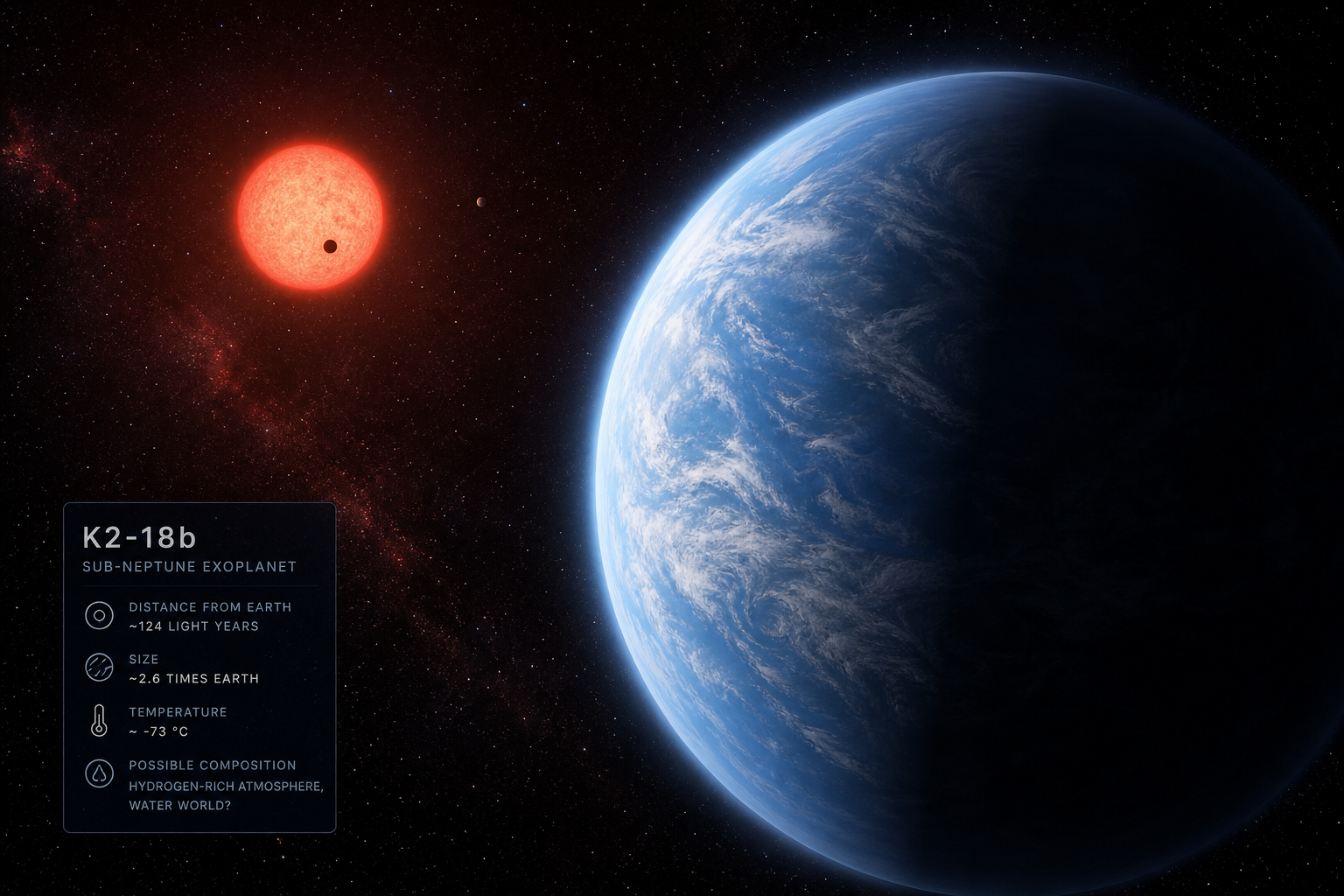
The announcement generated enormous public excitement, but it also triggered intense scientific scrutiny. A NASA-led reanalysis published in July 2025 confirmed that K2-18b does indeed have a water-rich, complex atmosphere, but it found no conclusive evidence for DMS specifically—highlighting just how difficult it is to interpret faint atmospheric signals with confidence. Several independent research teams reached similar conclusions. Their analyses found no strong statistical evidence for either DMS or a related compound, dimethyl disulfide (DMDS). The spectral features associated with these molecules sit near the threshold of detectable noise, and crucially, they aren't uniquely attributable to those specific gases—several other sulfur- or carbon-based molecules could produce comparable signals given the same data.
One particularly telling reanalysis found that the strength of the apparent detection depended heavily on how the data was processed: using an alternative method for grouping, or "binning," the wavelength data, 87.5% of the resulting analyses failed to support the original detection claim. Even more notably, the original research team's own follow-up work acknowledged this ambiguity. Their reanalysis confirmed the presence of methane with reasonably high confidence, but found no statistically significant evidence for either carbon dioxide or DMS in the same dataset that had initially generated headlines.
This situation has pushed some scientists toward a more cautious, even skeptical, long-term outlook. There's a growing concern within the field that we may never be able to definitively claim the discovery of a biosignature gas using JWST alone—not necessarily because the telescope lacks raw sensitivity, but because interpreting complex, noisy atmospheric data in a way that rules out every plausible alternative explanation is extraordinarily difficult.
Importantly, this isn't really a dispute about whether the underlying data from K2-18b is real—researchers broadly agree that the signal itself exists. The disagreement lies in interpretation: what molecule, or combination of molecules, actually produced it. As one researcher involved in the debate put it, if a more mundane molecule like ethane—a compound already known to exist in atmospheres throughout our own solar system—can explain the observed data, then scientists shouldn't leap to a more exotic and biologically suggestive explanation like DMS unless every other, simpler possibility has been thoroughly ruled out. It's a principle that echoes a long-standing tenet of scientific reasoning: extraordinary claims require extraordinary evidence.
Building the Next Generation of Tools
Rather than being discouraged by these limitations, the exoplanet research community has responded by investing heavily in a new generation of purpose-built missions designed to overcome exactly these kinds of obstacles.
PLATO, a mission from the European Space Agency, is set to join the fleet of exoplanet-hunting observatories in 2026. Its focus will be on detecting Earth-like planets in long orbits around Sun-like stars—precisely the kind of systems that are hardest for current instruments to characterize in detail.
Ariel, another ESA mission, recently cleared a major hardware milestone in May 2026, when its payload passed critical testing. Ariel is designed specifically for atmospheric spectroscopy, and its goal is ambitious: surveying the atmospheres of roughly 1,000 transiting exoplanets. The mission is scheduled to launch in 2029, and its scale means it will approach atmospheric characterization not as a series of isolated case studies, but as a statistical survey across an enormous population of worlds.
NASA, meanwhile, is preparing to launch the Nancy Grace Roman Space Telescope by May 2027. Roman will take a different approach to planet-hunting, relying primarily on gravitational microlensing to detect new worlds—a technique particularly well-suited to finding planets at greater distances from their stars, complementing the strengths of transit-based surveys like TESS.
The most ambitious mission on the horizon is the Habitable Worlds Observatory (HWO), envisioned as NASA's flagship successor in the search for life beyond Earth. It would be the first telescope purpose-built specifically to search for signs of life on planets orbiting other stars, with a primary objective of directly imaging 25 potentially habitable worlds. This kind of direct imaging capability, if achieved, could sidestep some of the interpretive challenges that have plagued transit spectroscopy studies like the K2-18b case.
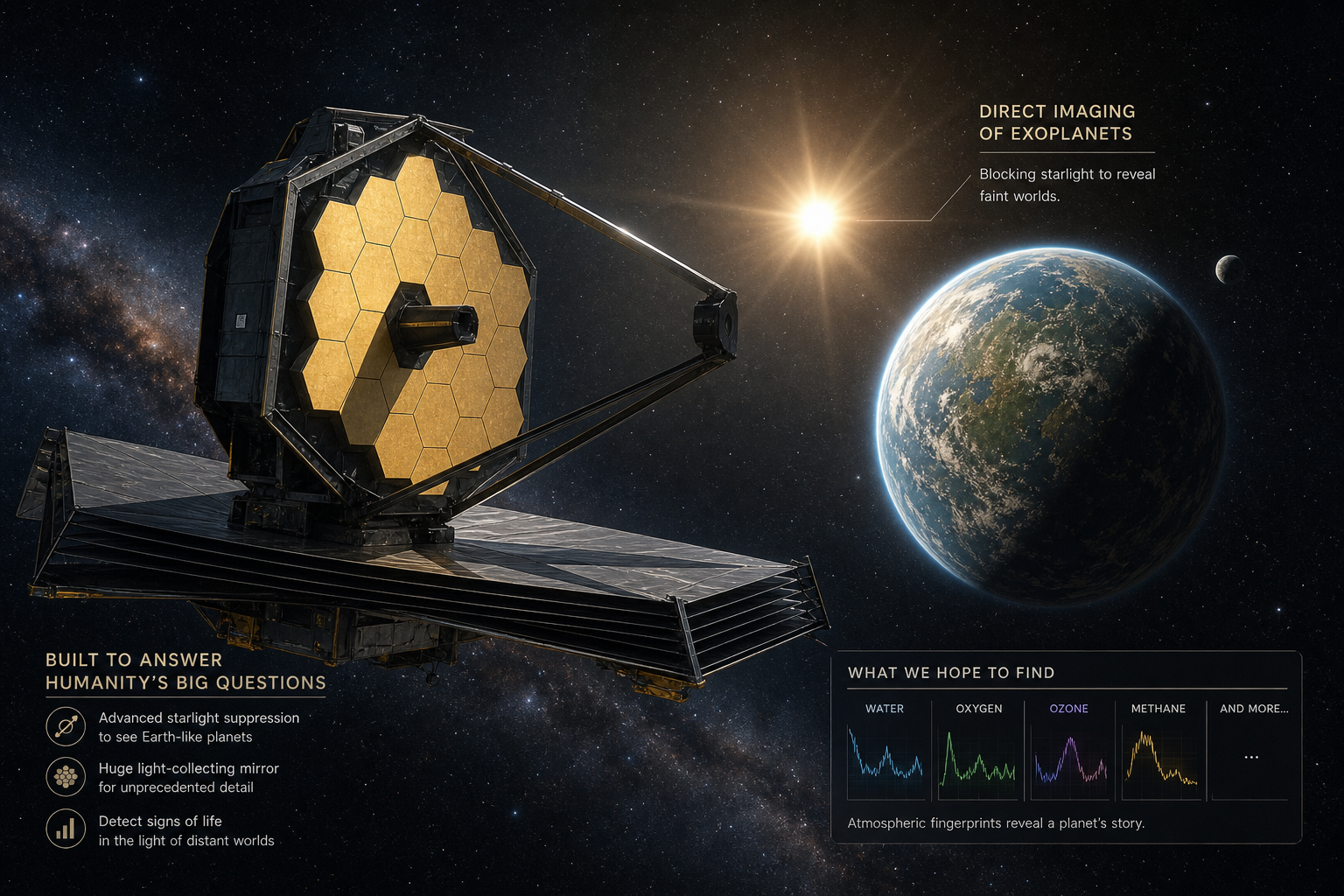
However, HWO faces serious headwinds—not technical, but financial. The proposed 2027 NASA budget requested just $5 million for the mission, a dramatic reduction from the $150 million that Congress had enacted for it in fiscal year 2026. Given this funding uncertainty, HWO's launch isn't expected until sometime in the 2040s, meaning the most powerful tool designed specifically to answer the question of life elsewhere may still be decades away.
Where Things Stand
Taken together, the state of exoplanet science in 2026 reveals two parallel and somewhat contrasting realities. Discovery itself is thriving: the confirmed planet count continues climbing steadily, imaging techniques are achieving new milestones like the Beta Pictoris system, and workhorse missions like TESS keep adding new candidates to the catalog every week. But the search for life—the deeper question that motivates so much public fascination with exoplanets—has entered a more rigorous and appropriately skeptical phase.
The K2-18b controversy has become something of a cautionary benchmark for the field, illustrating how early excitement over a tantalizing signal can outpace the statistical rigor needed to make a truly confident claim. At the same time, practical hardware limitations—stellar noise from active M-dwarfs, and the sheer number of observations needed to detect faint atmospheric gases—are driving substantial investment in specialized future missions. Whether those missions, particularly the ambitious but underfunded Habitable Worlds Observatory, receive the resources and timeline they need may ultimately determine how much longer humanity has to wait before answering one of its oldest and most profound questions: are we alone?