For nearly two years, one of the biggest stories in cosmology has been a slow-building hint that dark energy—the mysterious force accelerating the expansion of the universe—might not be the fixed, unchanging quantity that Einstein's equations originally allowed for. Instead, it might be evolving over billions of years.
Then, in the summer of 2026, a single dataset managed to both weaken and strengthen that case in the same breath. Researchers have taken to calling it a "whiplash," and understanding why requires a quick trip through how this dark energy mystery has unfolded.
A Quick Recap: Why Dark Energy Is Already Strange
When astronomers discovered in the late 1990s that the universe's expansion is not just continuing but accelerating, they needed to add something new to their equations. That something became known as dark energy, and for decades the simplest and most successful description of it has been the "cosmological constant"—a fixed energy density built into the fabric of space itself, usually labeled with the Greek letter Lambda (Λ).
Combined with cold dark matter (CDM), this gives us the standard model of cosmology, known as ΛCDM, which has done a remarkably good job explaining observations of the universe for a quarter of a century.
But a fixed cosmological constant is also, in a sense, an assumption of convenience. Nothing in physics guarantees that dark energy has to be constant. It could instead be dynamical—weakening or strengthening as the universe ages. Testing that possibility requires extraordinarily precise maps of the universe's structure across cosmic time, which is exactly what the Dark Energy Spectroscopic Instrument, or DESI, was built to produce.
The Build-Up: DESI's Growing Hint of Evolving Dark Energy
DESI, mounted on the Mayall Telescope in Arizona, has spent recent years mapping millions of galaxies and quasars to measure how matter is distributed across the universe at different distances—and therefore different points in cosmic history. By combining these maps with data from the cosmic microwave background (the ancient afterglow of the Big Bang) and with several independent supernova surveys, the DESI collaboration began to notice something odd.
In DESI's first data release (DR1) in March 2025, the data showed departures from standard ΛCDM at statistical significances of 2.6, 2.5, 3.5, and 3.9 sigma, depending on which supernova sample was combined with the DESI and CMB data. When DESI's second data release (DR2) arrived, those numbers climbed further, reaching 2.8, 3.8, and 4.2 sigma with different supernova samples.
In physics, "sigma" is a measure of how unlikely a result would be if it were just a statistical fluke. A 3-sigma result has roughly a 0.3% chance of being a random accident. That sounds compelling, but physicists have a long institutional memory of 3-sigma anomalies that looked exciting for a while and then quietly disappeared as more data came in. The traditional bar for declaring an actual discovery is 5 sigma—a much higher standard that DESI's results, even at their strongest, had not yet reached.
Still, the trend was intriguing enough that Andrei Cuceu, co-chair of DESI's Lyman-alpha working group at Berkeley Lab, offered a fittingly open-minded assessment: "We're in the business of letting the universe tell us how it works, and maybe the universe is telling us it's more complicated than we thought it was."
The promise of the evolving dark energy hint was significant enough that in April 2026, the DESI collaboration announced it would extend its observing campaign into 2028, expanding its cosmic map even further in hopes of resolving the question one way or another.
Enter the Lyman-Alpha Forest
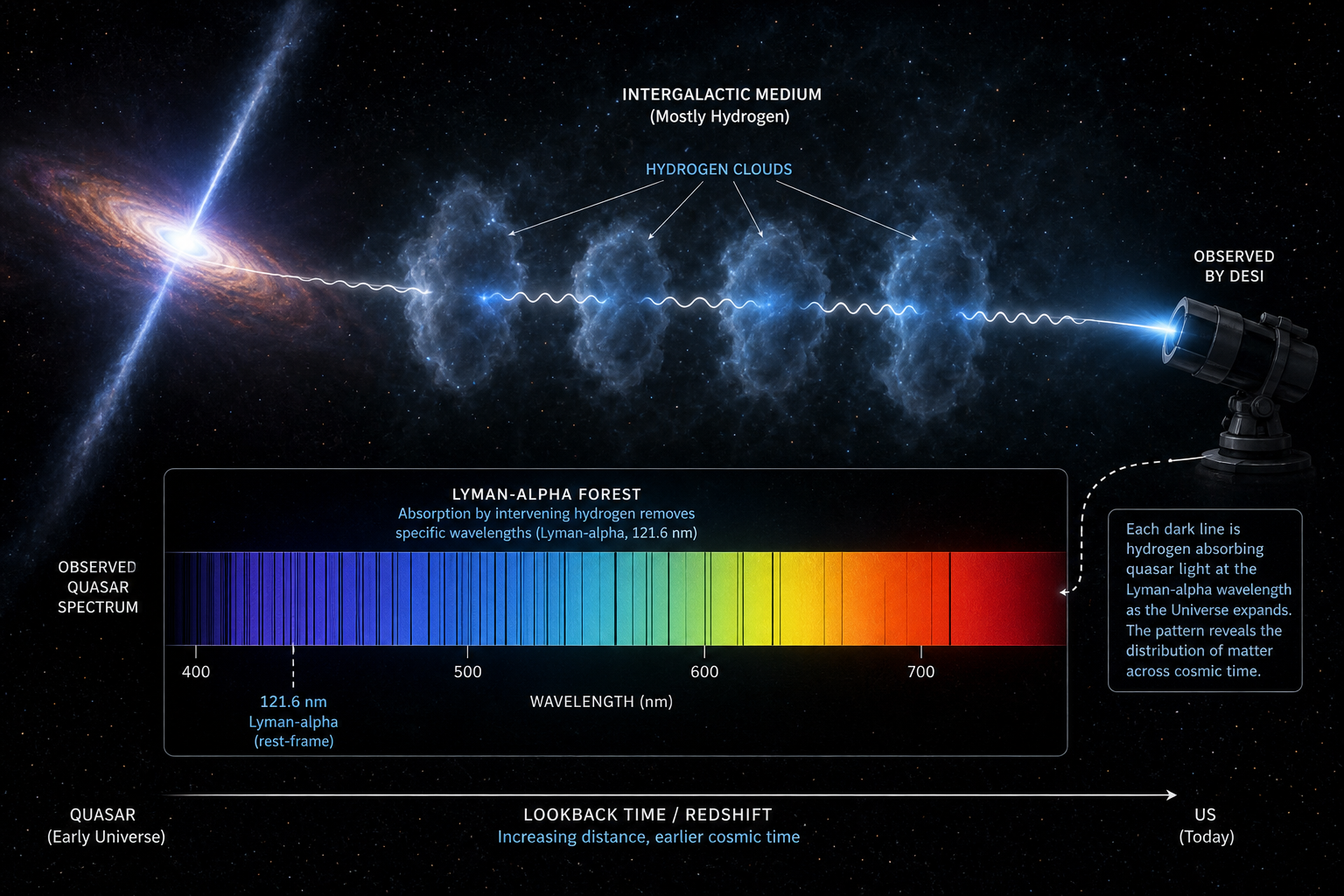
To understand the July 2026 twist, it helps to know what the "Lyman-alpha forest" actually is. When light from a very distant, extremely bright object—typically a quasar—travels toward Earth, it passes through countless clouds of intervening hydrogen gas scattered throughout intergalactic space.
Each cloud absorbs a small sliver of that light at a specific wavelength related to hydrogen's Lyman-alpha transition, but because the clouds are all at slightly different distances (and therefore slightly different cosmological redshifts), each absorption feature gets shifted by a different amount. The result, when you look at the quasar's spectrum, is a dense series of absorption dips that resembles a forest of trees—hence the name.
This technique is uniquely powerful because it lets astronomers trace the distribution of matter on very small scales and at very high redshifts—reaching back more than 11 billion years into cosmic history, to eras that galaxy surveys alone simply cannot access. No galaxy redshift survey can probe matter clustering on the fine scales that the Lyman-alpha forest reveals, which makes it an important independent cross-check on other dark energy measurements.
The July 30, 2026 Results: A Twist With Two Faces
On July 30, 2026, the DESI collaboration released its dedicated Lyman-alpha forest full-shape and Alcock-Paczyński (AP) analysis, drawing on the full accumulated Lyman-alpha dataset from DR2. This was, by DESI's own account, the most precise cosmological analysis yet produced from this particular probe.
The headline results were striking in their precision. The new measurements constrained the Alcock-Paczyński effect—a geometric test sensitive to the expansion history of the universe—to about 1% precision at an effective redshift of 2.33. That's twice as tight as the equivalent constraint from the baryon acoustic oscillation (BAO) measurement using the same dataset. Because DR2's Lyman-alpha sample is roughly twice the size of DR1's, the improvement in precision was substantial.
But precision is only part of the story. What really caught the cosmology community's attention was what the data actually showed—and here is where the "whiplash" comes in.
First, the undercutting. Taken entirely on its own, the new Lyman-alpha data lines up comfortably with standard ΛCDM cosmology. There is no strong signal in this dataset alone pointing toward an evolving dark energy component. As DESI's own summary of the results put it, this raises two possibilities: either the broader hints of evolving dark energy seen elsewhere may eventually fade away as more data accumulates, or a more complex cosmological model is needed to make all the different pieces of evidence—Lyman-alpha, galaxy clustering, supernovae, and the CMB—fit together consistently.
Then, the reviving. Despite that internal consistency with the standard model, when the Lyman-alpha data is folded into the broader DESI DR2 analysis alongside CMB and supernova data, the preference for evolving dark energy does not go away. If anything, it holds firm or even strengthens in some combinations. The formal DESI DR2 Results IV paper found that a time-evolving dark energy model—commonly parametrized using two numbers called w0 and wa that describe how dark energy's equation of state changes over cosmic time—is preferred over standard ΛCDM at 2.7 sigma when combining DESI with CMB data, rising to 3.2 sigma when supernova data is added as well.
In other words: the single most powerful independent probe of high-redshift cosmology looks, by itself, like nothing more than business as usual for the cosmological constant. Yet the overall multi-probe statistical case for a dynamical dark energy component survives essentially intact. That combination—one dataset simultaneously undercutting and reinforcing the same scientific narrative—is what has earned 2026 its reputation as the year of dark energy's whiplash.
The table below summarizes how the statistical significance of the evolving dark energy signal has shifted across DESI's major releases:
| Data Release | Probes Combined | Significance vs. ΛCDM |
|---|---|---|
| DR1 (March 2025) | DESI + CMB + various supernova samples | 2.6, 2.5, 3.5, 3.9 σ |
| DR2 (2025) | DESI + CMB + various supernova samples | 2.8, 3.8, 4.2 σ |
| DR2 Lyman-alpha alone (July 2026) | Lyman-alpha forest only | Consistent with ΛCDM (no significant tension) |
| DR2 Results IV (July 2026) | Lyman-alpha + DESI + CMB | 2.7 σ |
| DR2 Results IV (July 2026) | Lyman-alpha + DESI + CMB + supernovae | 3.2 σ |
There was also a smaller, but notable, silver lining buried in the analysis. The new Lyman-alpha measurements slightly eased a separate tension that had been present in DESI's results relative to the cosmic microwave background, nudging that particular discrepancy down from 2.4 sigma to 2.2 sigma. It's a modest shift, but a welcome one, since reducing tensions between independent probes generally makes a dataset more internally consistent and easier to trust.
An Unexpected Bonus: Tightening the Neutrino Mass Limit
The same Lyman-alpha analysis also produced an important side benefit unrelated to dark energy directly: a tighter constraint on the sum of neutrino masses. Neutrinos are famously light, nearly massless particles, but the exact scale of their masses—and the order in which the three known neutrino types are arranged, called the "mass ordering"—remains one of the open questions in particle physics.
DESI's Lyman-alpha data pushed the upper limit on the sum of neutrino masses down to 0.0642 electron-volts. That number matters because it's approaching a theoretical floor that, if crossed, could definitively rule out one of the two possible neutrino mass orderings that physicists currently consider viable. It's a reminder that cosmological surveys like DESI, while designed primarily to study dark energy and the large-scale structure of the universe, also double as sensitive laboratories for fundamental particle physics.
Theoretical Groundwork: What Would Evolving Dark Energy Actually Look Like?
Even before the July 2026 Lyman-alpha results arrived, theorists had been working out what a genuine signature of dynamical dark energy should look like in this kind of data, so that observers would know what to search for. A companion theoretical paper by Garza and collaborators, published in January 2026, modeled how dynamical dark energy models consistent with DESI's earlier constraints would imprint themselves on the Lyman-alpha forest.
The team found that such models should produce a distinctive spectral tilt in the forest's transmitted flux power spectrum—a scale- and redshift-dependent signature that would look different from what standard ΛCDM predicts. They further predicted that these dynamical dark energy scenarios should correspond to higher temperatures in the intergalactic medium and reduced Lyman-alpha opacity compared to the standard model's expectations. This kind of theoretical groundwork is essential: it gives observational teams like DESI's a specific, falsifiable prediction to test against, rather than simply comparing overall statistical fits after the fact.
A Community That Has Been Burned Before
Throughout this entire saga, members of the DESI collaboration and the broader cosmology community have repeatedly urged caution. This isn't the first time an intriguing anomaly has appeared in cosmological data only to fade with more observations, and researchers are acutely aware of that history.
As reported by Quanta Magazine, DESI collaboration member Dillon Brout—who had earlier co-founded the Dark Energy Survey—spoke from experience about having been "burnt" before by cosmological anomalies that looked promising early on but ultimately disappeared once larger datasets came in. That kind of institutional memory is part of why the DESI team continues to describe even their most statistically significant findings as a "hint" rather than a discovery, and why they've committed to extending observations through 2028 in the hopes of getting a clearer answer.
What Comes Next
The 2026 Lyman-alpha results leave cosmologists in a genuinely uncertain, and scientifically exciting, position. The data don't definitively confirm evolving dark energy, but they also don't kill the idea, despite offering a dataset that—on its own—looks perfectly ordinary. That apparent contradiction is exactly the kind of puzzle that drives large collaborations to keep collecting data rather than declare victory or defeat prematurely.
With DESI's observing campaign now extended into 2028, and with theoretical frameworks like the Garza et al. model providing specific predictions to test against, the coming years should bring larger datasets, tighter constraints, and hopefully a clearer verdict. Until then, the honest scientific summary remains what it has been throughout this whole story: dark energy might be evolving, and the universe seems to be hinting at complexity beyond the simplest model—but nature has not yet spoken with enough certainty for anyone to be sure.