Every night, telescopes around the world and in orbit capture more data than astronomers could examine in a lifetime. A single observatory can now produce terabytes of images in a matter of hours, filled with galaxies, stars, and transient flashes of light that might reveal a supernova, a colliding pair of black holes, or a planet orbiting a distant sun. Sorting through this avalanche of information by hand is no longer realistic. That's where artificial intelligence has quietly become one of the most important tools in modern astronomy.
AI is not replacing astronomers. Instead, it's becoming a collaborator—flagging unusual signals, classifying objects, scheduling observations, and helping researchers extract precise measurements from noisy, complex datasets. As Stella Offner, an astronomy professor at the University of Texas at Austin, has noted in a review of the field, AI is being integrated into a wide range of astronomical tasks, from model fitting to anomaly detection, even though its current capabilities and trustworthiness still fall short of full integration into every part of the research process. That nuanced picture—genuine progress paired with real limitations—defines where AI-assisted astronomy stands today.
The shift is significant enough that universities are building formal programs around it. Carnegie Mellon University, for example, launched its Keystone Astronomy & AI Visiting Fellows Program with support from the Simons Foundation, bringing together experts in artificial intelligence, statistics, and astrophysics specifically to accelerate the use of AI in cosmological and astronomical research. This kind of institutional investment reflects a broader recognition: the next era of astronomical discovery will depend heavily on how well humans and machine learning systems work together.
Finding New Worlds Faster
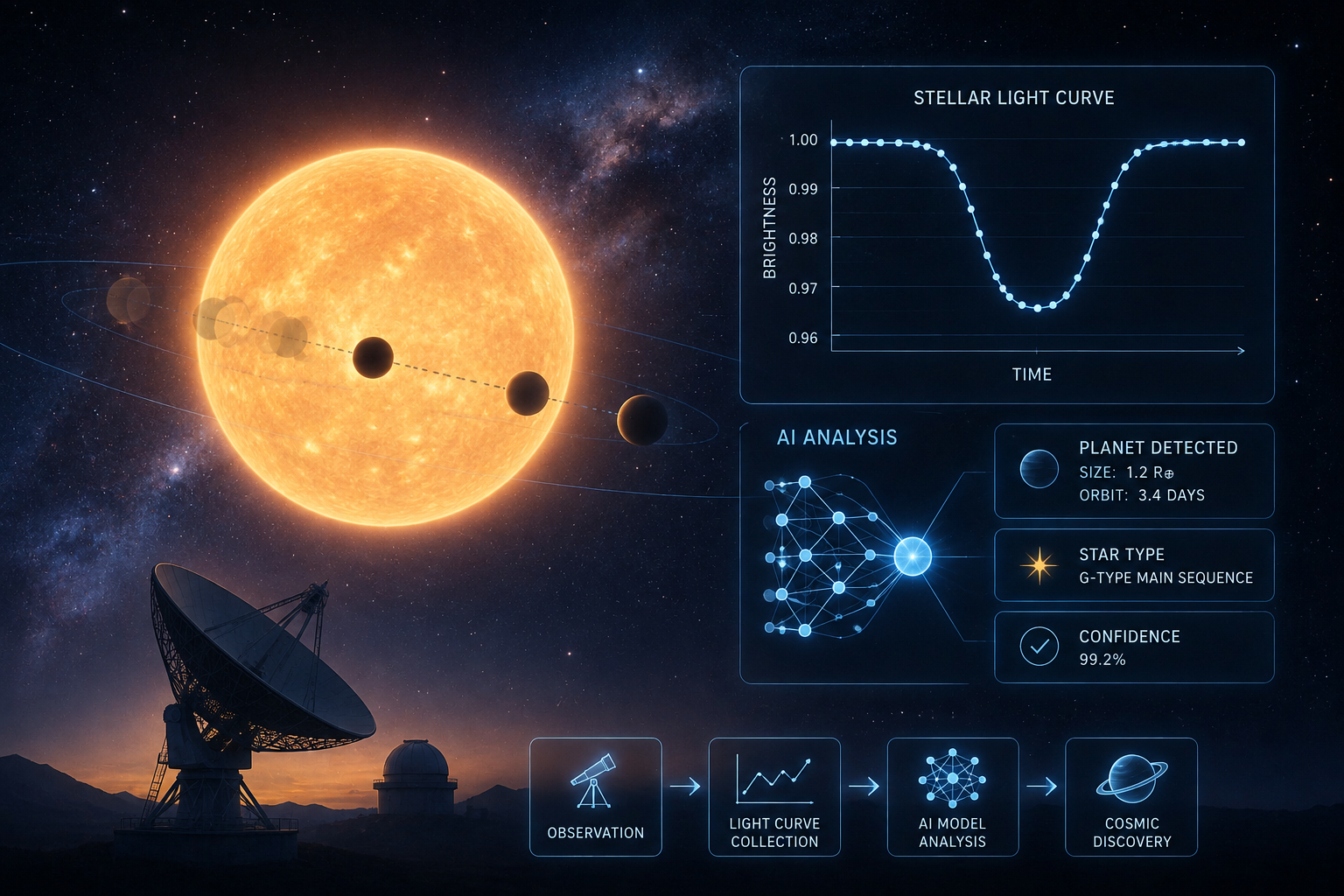
One of the clearest success stories comes from the search for exoplanets—planets orbiting stars beyond our solar system. In 2026, astronomers at Warwick achieved a major milestone by confirming more than 100 exoplanets, including 31 newly identified worlds, using an AI system applied to data from NASA's Transiting Exoplanet Survey Satellite (TESS).
Finding exoplanets is tricky because the signals they produce—tiny, periodic dips in a star's brightness as a planet passes in front of it—can be mimicked by other phenomena, such as pairs of orbiting stars or simple instrument glitches. The Warwick team's system was trained on realistic simulations to recognize the difference between a genuine planetary signal and these false alarms. Only after filtering out the noise does the system statistically confirm the strongest remaining candidates. This approach allows astronomers to process far more data than manual vetting would allow, while maintaining rigorous standards for what counts as a confirmed discovery.
Digging Through Decades of Archived Images
AI isn't just helping with new observations—it's also unlocking discoveries hidden in data that has been sitting in archives for years. In January 2026, NASA reported that astronomers used an AI-assisted technique to comb through nearly 100 million image cutouts from the Hubble Legacy Archive, searching for rare and unusual objects that might have been overlooked.
The results were striking: in just two and a half days, the team identified more than 1,300 odd-appearing objects, more than 800 of which had never been documented before. Many turned out to be galaxies caught in the act of merging, displaying unusual shapes or long streams of stars and gas stretched out by gravitational interactions. This kind of large-scale anomaly detection would be extraordinarily time-consuming for humans to do manually, but it plays to one of AI's clearest strengths: spotting patterns—and departures from patterns—across enormous datasets.
Teaching General-Purpose AI to Read the Sky
Perhaps one of the more surprising developments has been the use of general-purpose language models, not just specialized astronomy software, to help interpret cosmic events. A 2025 study published in Nature Astronomy demonstrated that Google's Gemini model could be adapted into a capable astronomy assistant with only minimal guidance.
The research team found that Gemini could classify real astronomical transient events—like exploding stars, black holes shredding stars, asteroids, or stellar flares—with approximately 93% accuracy, using just 15 training images and a plain-English instruction prompt. Remarkably, the system could also explain its reasoning in a way that felt coherent to experts. By adding a self-correction loop, in which the AI reviewed and refined its own conclusions, the researchers pushed performance on one dataset from 93.4% up to 96.7%. When a panel of 12 professional astronomers reviewed the AI's written explanations, they rated them as highly coherent and useful.
This matters because it suggests that even AI systems not specifically built for astronomy can be quickly adapted to specialized scientific tasks, potentially lowering the barrier for smaller research teams to use advanced classification tools without building complex custom software from scratch.
Coping With an Unprecedented Flood of Data
If there's one factor driving the astronomy community toward AI faster than any other, it's simply the sheer scale of incoming data. The Vera Rubin Observatory offers perhaps the most dramatic example. After releasing its first full-system images in June 2025 using a 3,200-megapixel camera, Rubin is set to begin full operations of its Legacy Survey of Space and Time in 2026. Once running, it's expected to generate roughly 20 terabytes of raw data every single night and discover an estimated 2,000 new supernovae nightly.
To put that in perspective, all telescopes on Earth combined currently find roughly 40,000 supernovae per year. Rubin alone is expected to surpass that total every three weeks, sustained over a full decade of operations. At that scale, there is no realistic scenario in which teams of human astronomers could review every detection manually. As one assessment of the observatory's capabilities bluntly put it, the real choice isn't between human analysis and automated analysis—at this volume, it's between AI-assisted analysis and simply leaving most of the data unexamined.
Rubin isn't alone in generating this kind of firehose. The Euclid space observatory is in the midst of a six-year mission to image one-third of the infrared sky at resolution comparable to the Hubble Space Telescope. That volume of imagery is far beyond what even large crowdsourced citizen-science efforts could fully review, making automated tools an essential part of the pipeline rather than an optional convenience.
| Instrument/Survey | Data Challenge | AI Role |
|---|---|---|
| Vera Rubin Observatory (LSST) | ~20 TB of raw data nightly; ~2,000 new supernovae per night | Automated detection and triage to avoid unexamined data |
| Euclid | Imaging one-third of the infrared sky at Hubble-like resolution over six years | Automated review beyond citizen-science capacity |
| TESS (Warwick exoplanet search) | Tiny periodic brightness dips buried in noise and false positives | Trained classifier filters false alarms before statistical confirmation |
| Hubble Legacy Archive | ~100 million archived image cutouts | Anomaly detection surfaced 1,300+ unusual objects in 2.5 days |
| LOFAR (ROAD system) | Continuous radio data streams | Anomaly detector flags solar storms, equipment failures (F-2 score 0.92) |
| CHIME | Continuous radio data streams | Real-time pipeline flags fast radio burst candidates |
| Allen Telescope Array | Large volume of sky and signal types | New AI system processes data ~600x faster than predecessor |
Telescopes That Plan Their Own Nights
AI's role is expanding beyond data analysis and into the operation of the telescopes themselves. In July 2026, a deep-learning system trained on historical telescope observations began generating and adapting observing schedules in real time for the Blanco Telescope's Dark Energy Camera—one of the first instances of a fully AI-driven telescope operation schedule.
Similar systems, such as StarWhisper Telescope, are designed to automate the entire observation process end-to-end: generating lists of targets, executing real-time image analysis as data comes in, and automatically triggering follow-up observations when something unusual, like a transient event, is detected. This kind of automation means telescopes can react to fast-changing cosmic events—like a newly detected supernova or gravitational wave source—far more quickly than a human-run scheduling process would typically allow.
Listening for Ripples in Spacetime
Gravitational wave astronomy, the study of ripples in spacetime produced by cataclysmic events like colliding black holes and neutron stars, has also become fertile ground for AI applications. Google DeepMind, working with the LIGO collaboration, developed a tool called Deep Loop Shaping, which has been shown to enhance LIGO's ability to track these faint spacetime distortions.
AI is also influencing the design of future detectors. Researchers used an algorithm called Urania to explore an enormous space of possible detector configurations, uncovering novel design approaches that could potentially enhance detection capabilities by more than an order of magnitude compared to current instruments.
Even with existing detectors, machine learning plays a crucial supporting role. LIGO's sensitivity is often limited not by the faintness of the gravitational wave signals themselves, but by complex instrumental and environmental noise that can mask or mimic genuine detections. Machine learning has emerged as a powerful tool for characterizing and mitigating these noise sources, including the use of computer vision techniques—similar to those used in object-detection systems like YOLO—to automatically identify and pinpoint the source of noise artifacts in the data.
Sharpening Our View of Dark Matter and Dark Energy
Some of the most profound mysteries in cosmology involve substances and forces we can't directly see: dark matter and dark energy. AI is helping researchers extract more precise information about these phenomena from existing observations, rather than requiring entirely new datasets.
A study led by University College London using data from the Dark Energy Survey found that applying AI to infer dark energy properties from a map of dark and visible matter—covering the last 7 billion years of cosmic history—doubled the precision at which key characteristics of the universe could be measured. Lead researcher Niall Jeffrey explained the approach this way: "Using AI to learn from computer-simulated universes, we increased the precision of our estimates of key properties of the universe by a factor of two." He added a striking comparison to illustrate the significance of this gain: achieving the same level of precision without AI would have required roughly four times the amount of observational data—equivalent to mapping an additional 300 million galaxies.
This kind of efficiency gain matters enormously in cosmology, where collecting new data can take years and cost enormous sums. If AI techniques can extract more scientific value from data that's already been collected, that represents a meaningful acceleration in the pace of discovery.
Catching Radio Signals From the Deep Universe
Radio astronomy has its own version of the data deluge problem, and AI systems are increasingly stepping in to help. The Radio Observatory Anomaly Detector, known as ROAD, has been applied to data from the LOFAR telescope to identify anomalies such as solar storms or electronic failures, achieving a high F-2 score of 0.92—a statistical measure that reflects strong performance in correctly identifying true anomalies while minimizing false alarms.
The CHIME radio telescope uses a real-time machine learning pipeline to identify candidates for fast radio bursts—brief, intense flashes of radio energy from deep space whose origins remain an active area of research—as they emerge from continuous streams of incoming data. Meanwhile, at the Allen Telescope Array, a newer AI system now processes data roughly 600 times faster than its predecessor, dramatically expanding the volume of sky and signal types researchers can realistically monitor.
A Tool, Not a Replacement
Across all these applications, a consistent picture emerges. Multiple researchers and reviews agree that the explosion in data volume from instruments like Rubin, Euclid, TESS, and LIGO is the primary force driving AI adoption in astronomy—the data has simply outgrown what human teams can process unaided. Anomaly detection and classification, in particular, stand out as AI's strongest current use cases: finding rare transients, unusual galaxy shapes, and faint exoplanet signals buried in noise.
Just as importantly, the research consistently frames AI as a collaborative tool rather than an autonomous decision-maker. Human experts remain deeply involved in validating findings, interpreting results, and deciding what deserves further investigation. This "human in the loop" approach reflects genuine caution within the field, not just a talking point.
That caution is well-founded. Offner's review specifically highlights that AI's current capabilities and trustworthiness fall short of full integration into astronomical workflows. A related concern raised in other assessments centers on interpretability: deep learning models can often classify objects or signals accurately without being able to explain why they reached that conclusion. In a field where understanding the underlying physical processes is the ultimate scientific goal, an accurate-but-unexplainable answer is only part of the solution. This lack of transparency makes it harder for researchers to fully trust AI-driven conclusions without independent verification, and it's likely to remain an active area of research and debate as these tools become more deeply embedded in astronomical practice.
Looking Ahead
What's clear is that artificial intelligence has already changed how astronomy is done—not by replacing the curiosity, judgment, and expertise of human researchers, but by extending what's possible within the limits of time, data volume, and computational resources. As next-generation observatories like Rubin and Euclid ramp up to full operations, and as instruments across the electromagnetic and gravitational-wave spectrum continue to generate ever-larger datasets, the partnership between human scientists and AI systems seems likely to deepen further.
The universe has always produced far more information than we've been able to fully capture and understand. AI won't answer the deepest questions about dark matter, dark energy, or the origins of cosmic structure on its own—but it may prove essential in helping human researchers find the clues hidden within the data, faster and more thoroughly than would otherwise be possible.