For decades, the story of our universe's birth has felt reassuringly settled: a single, unimaginably hot and dense point expanded outward roughly 13.8 billion years ago, cooling and stretching into the galaxies, stars, and planets we see today. But settled is no longer the right word. Across 2025 and into 2026, a wave of new observations and theoretical proposals has begun pulling at the threads of this standard picture, forcing cosmologists to ask hard questions about what actually happened at the beginning—and whether our best model of the universe needs a fundamental rewrite.
This isn't a crisis born of speculation. It's driven by increasingly precise data from some of the most ambitious instruments ever built, including a massive ground-based survey mapping millions of galaxies and a space telescope peering further back in time than any before it. Together, they're revealing a universe that behaves in ways the standard model didn't quite predict.
The Standard Model Faces Its Toughest Test Yet
Since the late 1990s, cosmologists have relied on a framework called Lambda-CDM, or ΛCDM. The name combines cold dark matter (the invisible material that makes up most of the universe's mass) with the Greek letter Lambda, representing the cosmological constant—a simple, unchanging form of dark energy thought to be accelerating the universe's expansion. For years, ΛCDM has done a remarkably good job explaining what we observe, from the distribution of galaxies to the afterglow of the Big Bang itself.
But cracks are showing. The Dark Energy Spectroscopic Instrument, or DESI, has been mapping the three-dimensional positions of millions of galaxies and quasars to trace how the universe has expanded over billions of years. Analysis released in 2025 found that DESI's data, taken on its own, remains consistent with standard ΛCDM. However, when researchers combined DESI's measurements with other major datasets—including the cosmic microwave background, distant supernovae, and the subtle bending of light known as weak gravitational lensing—something curious emerged: mounting hints that dark energy's influence may not be constant after all, but might actually be weakening over cosmic time.
Will Percival, a co-spokesperson for the DESI collaboration, summed up the shift in thinking: "We're guided by Occam's razor, and the simplest explanation for what we see is shifting... It's looking more and more like we may need to modify our standard model of cosmology to make these different datasets make sense together—and evolving dark energy seems promising."
This wasn't an isolated blip. The Dark Energy Survey released its final supernova dataset in January 2024, and the most striking results appeared when researchers allowed the properties of dark energy to vary rather than assuming it stays constant—producing a deviation from standard ΛCDM at roughly the 2-sigma level (a measure of statistical significance, where higher numbers indicate stronger evidence against the standard model). Then in April 2024, DESI's own first cosmological results showed no significant deviation on their own, but combining that data with cosmic microwave background measurements and supernova samples pushed the preference for evolving dark energy up to somewhere between 2.5 and 3.9 sigma. A more recent 2026 review confirmed these hints persist at the 2-4 sigma level, though it stopped short of declaring the cosmological tensions solved.
Not everyone reads the tea leaves the same way. A separate 2025 study concluded that standard ΛCDM cosmology remains a statistically robust description of the current universe overall, arguing that the newer datasets—particularly the latest DESI results and recent supernova samples—provide only moderate evidence for models where dark energy changes over time. This kind of disagreement is normal in an active field, and it underscores an important point: cosmologists are being appropriately cautious about whether these signals represent a genuine crack in our understanding of the universe, or whether they stem from subtle, unaccounted-for measurement errors.
The table below summarizes how the evidence for evolving dark energy has shifted across recent studies:
| Study / Dataset | Year | Statistical Significance | Conclusion |
|---|---|---|---|
| Dark Energy Survey (supernovae alone) | Jan 2024 | ~2 sigma | Mild deviation from ΛCDM when dark energy allowed to vary |
| DESI first cosmological results (alone) | Apr 2024 | Not significant | Consistent with standard ΛCDM |
| DESI + CMB + supernovae (combined) | Apr 2024 | 2.5–3.9 sigma | Preference for evolving dark energy |
| 2026 cosmology review | 2026 | 2–4 sigma | Hints persist; not yet conclusive |
| Separate 2025 robustness study | 2025 | N/A | ΛCDM still statistically robust overall |
The good news is that we won't have to wait indefinitely for clarity. DESI is expected to deliver refined constraints through 2025 and 2026, with a more comprehensive data release planned for 2027. Meanwhile, the Nancy Grace Roman Space Telescope, set to launch in 2026, and a proposed follow-up mission called DESI-II in the 2030s, will extend these investigations even further back in cosmic time.
Rethinking the Beginning: Life Beyond the Singularity
While the dark energy debate concerns how the universe has evolved, an equally significant challenge is emerging around how it began in the first place. The traditional Big Bang picture starts with a singularity: a single point of infinite density where our known laws of physics simply stop working. This has always been considered more of a placeholder than a real explanation, and in 2025 and 2026, several research teams proposed genuine alternatives.
One of the most striking comes from a team at the University of Portsmouth, led by Professor Enrique Gaztañaga. Rather than starting from a singularity, this model proposes that our universe formed through the gravitational collapse of matter into a massive black hole, followed by a "bounce" inside that black hole—meaning our entire observable universe may have effectively been born inside a black hole that formed within some larger, parent universe.
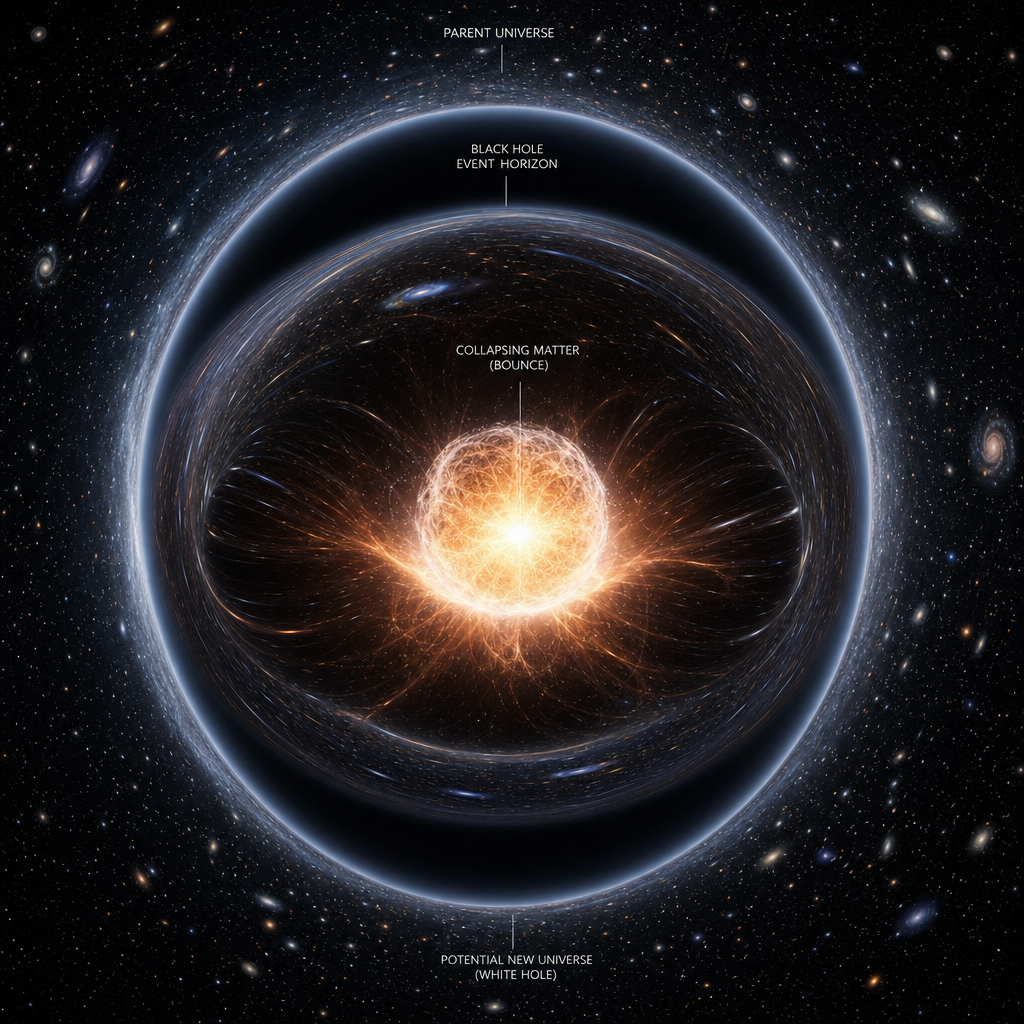
Gaztañaga is direct about what motivates this rethink: "the Big Bang model begins with a singularity – a point of infinite density where the laws of physics break down. This is not just a technical glitch; it's a deep theoretical problem that suggests we don't really understand the beginning at all."
What sets this proposal apart from pure speculation is that it makes testable predictions. As the researchers put it, "the smoking gun for our bouncing scenario is the presence of both a small spatial curvature and a small [cosmological constant] term"—specific, measurable properties of the universe that could confirm or rule out the model. Fittingly, this test won't remain purely theoretical: the European Space Agency's upcoming ARRAKIHS mission, for which Gaztañaga serves as Science Coordinator, will use four wide-angle telescopes to study the faint outer regions of galaxies, offering a real observational check on the black-hole-universe idea.
A second, quite different alternative comes from researchers at the University of Waterloo, published in March 2026 in Physical Review Letters under the title "Ultraviolet Completion of the Big Bang in Quadratic Gravity." This approach suggests that the universe's rapid early expansion may have emerged naturally from a deeper and more complete theory known as quantum gravity—an effort to unite general relativity (which governs gravity and large-scale structure) with quantum mechanics (which governs the behavior of particles at the smallest scales). Rather than treating the beginning of the universe as a breakdown of physics, this framework attempts to describe it using physics that remains consistent all the way down.
A third proposal, put forward in 2025 by researchers from Spain and Italy, challenges an entirely different pillar of modern cosmology: the theory of cosmic inflation, which holds that the universe underwent an incredibly brief period of exponential expansion just after the Big Bang. This new model suggests instead that the early universe originated from what's called de Sitter space, with quantum fluctuations and gravitational waves alone seeding the cosmic structures we see today—potentially eliminating the need for inflation and its more speculative parameters altogether.
It's worth being clear-eyed about where these ideas stand: none of them have been confirmed, and each faces significant theoretical and observational hurdles. But their emergence reflects a genuine and growing appetite within the physics community to move past the unsatisfying singularity at the heart of the classic Big Bang story.
What Telescopes Are Revealing About the Infant Universe
Much of this theoretical ferment is being driven by real observational surprises, especially from the James Webb Space Telescope (JWST). Since becoming operational, JWST's ability to peer deep into infrared light—stretched from the ultraviolet and visible light of ancient, distant objects—has let astronomers see further back in cosmic time than ever before, and what they're finding doesn't always match expectations.
In one striking result, Webb confirmed the earliest supernova detected to date: a dying star that exploded when the universe was only about 730 million years old, roughly 5 percent of its current age. Locating the faint, distant host galaxy of that explosion required exactly the kind of infrared sensitivity that makes JWST unique among space telescopes.
Webb has also spotted so-called "little green galaxies"—compact, intensely star-forming galaxies existing roughly one billion years after the Big Bang. These may have played a key role in reionization, the era when the first stars and galaxies flooded the universe with enough ultraviolet light to strip electrons from the neutral hydrogen that filled space, transforming the cosmos from an opaque fog into the transparent universe we observe today.
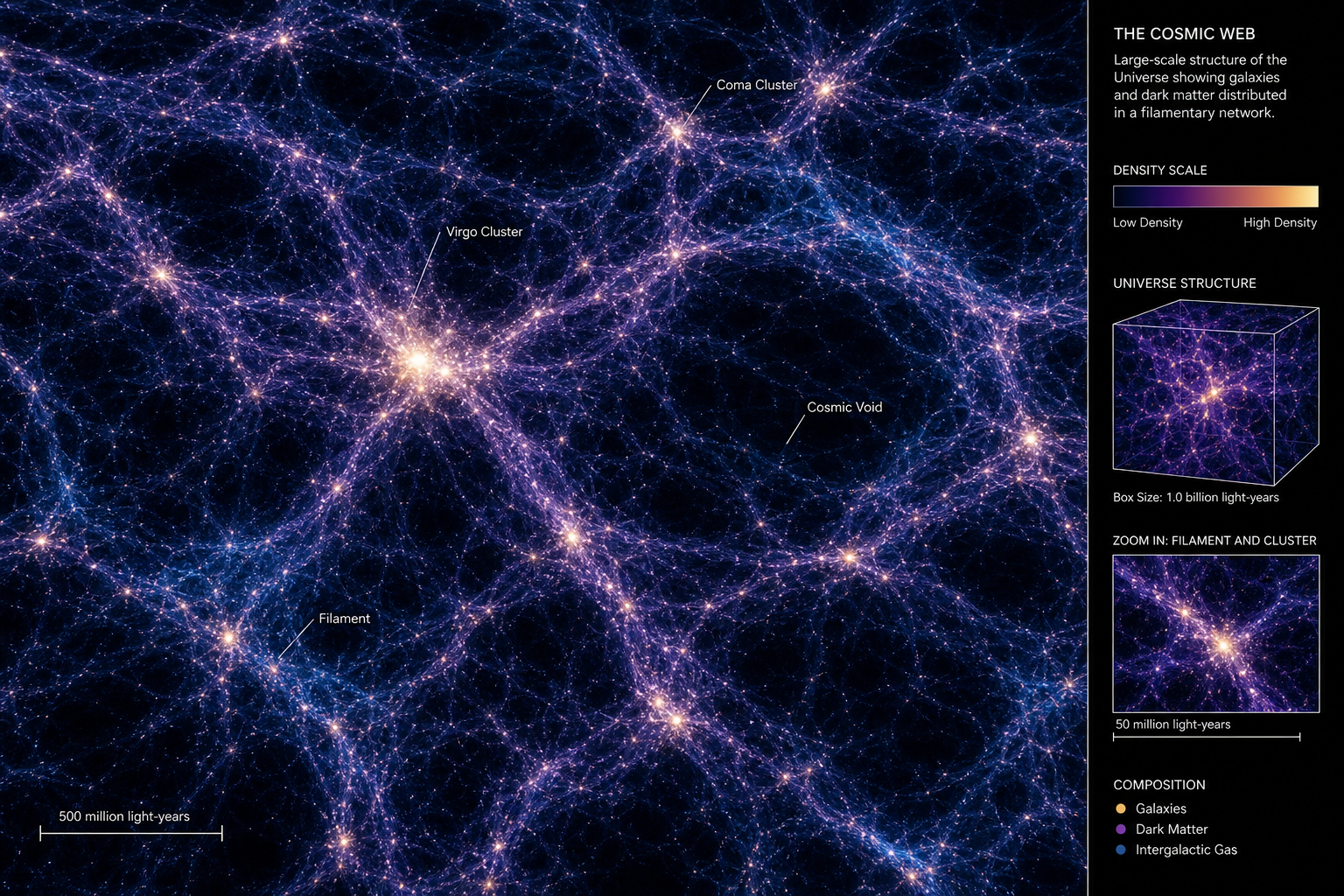
More recently, a May 2026 JWST survey produced what researchers describe as the clearest map yet of the universe's "cosmic web"—the vast, filament-like structure of galaxies and dark matter that spans the observable universe, connecting galaxy clusters like threads in an enormous cosmic net.
Not all of Webb's discoveries have fit neatly into existing theory, though. Since the telescope began its deep imaging campaigns in 2022, astronomers have repeatedly found mysterious objects nicknamed "little red dots": compact, extraordinarily luminous points of light so bright, at such early cosmic times, that the standard model of cosmology has struggled to explain how they could have formed so quickly. These objects remain a subject of active debate, and resolving their nature could have real implications for how we understand galaxy and black hole formation in the universe's first billion years.
Listening to the Universe's Oldest Light
Beyond distant galaxies and supernovae, scientists are also refining their view of the cosmic microwave background (CMB)—the faint afterglow of radiation left over from roughly 380,000 years after the Big Bang, when the universe first became transparent to light. This radiation is often called a baby picture of the universe, and every improvement in how precisely we can measure it offers new clues about cosmic origins.
In 2025, ground-based telescopes achieved what researchers describe as an unprecedented feat: detecting ultra-faint polarized light scattered by the universe's very first stars. This kind of measurement is extraordinarily difficult, since the signal from those earliest stars is exceptionally weak and easily drowned out by noise, but success here opens a new observational window onto the era when the universe's first light sources switched on.
Separately, researchers are investigating a phenomenon called cosmic birefringence: a subtle twist in the polarization of the universe's oldest light, which, if confirmed, could hint at new physics beyond the standard model. Scientists are actively developing improved techniques to reduce the measurement uncertainty surrounding this effect, which remains a promising but unresolved area of study.
The Persistent Puzzle of the Hubble Tension
No discussion of modern cosmological challenges would be complete without mentioning the Hubble tension—a long-standing and still-unresolved discrepancy between different methods used to measure how fast the universe is expanding today. Measurements based on nearby stars and galaxies tend to produce a different expansion rate than measurements based on the early universe's cosmic microwave background, and despite years of scrutiny, no single explanation has definitively resolved the gap.
One intriguing proposal put forward in 2025 suggests that our own galaxy might reside within a colossal cosmic bubble—roughly a billion light-years wide—where local matter density is somewhat lower than the cosmic average, subtly accelerating the expansion rate we measure nearby. If true, this could help reconcile the conflicting measurements. However, this remains just one hypothesis among several competing explanations, and it has not achieved consensus support within the cosmology community.
A Universe Still Full of Questions
Stepping back, a few things are becoming increasingly clear across this diverse body of research. Nearly every strand of evidence agrees that JWST has revealed genuine, unexpected features of the early universe that put real strain on simple cosmological models. There's also broad recognition that ΛCDM, despite decades of observational success, carries real theoretical weaknesses—chief among them the troubling singularity problem at the very beginning. And there's a shared understanding that upcoming instruments and datasets, from DESI's future data releases to the Roman Space Telescope, will be essential in determining whether we're witnessing the first signs of a genuine paradigm shift, or simply the ordinary growing pains of a maturing science.
What makes this moment in cosmology exciting isn't that we have definitive new answers about how the universe began. It's that, for the first time in a generation, multiple independent lines of evidence are converging to suggest the standard story may be incomplete—and that scientists across the world are proposing genuinely novel, testable ideas to fill the gaps. Whether the answer turns out to be evolving dark energy, a universe born from a black hole, quantum gravity smoothing away the singularity, or something not yet imagined, the next few years of observations promise to bring us closer to understanding not just what the universe is doing now, but how it came to exist at all.